

Why Your Sleeping Bag Fill Specification Directly Affects User Safety and Operating Costs
For commercial outdoor operators, procurement teams, and rental fleet managers, the choice between synthetic and down sleeping bag fill is not merely a preference for campers. It is a specification decision that impacts equipment lifespan, guest satisfaction, maintenance budgets, and operational safety. This guide provides a technical comparison to help you select the appropriate fill material based on your specific use case, environment, and commercial goals.
Understanding Sleeping Bag Fill: The Core Performance Mechanism
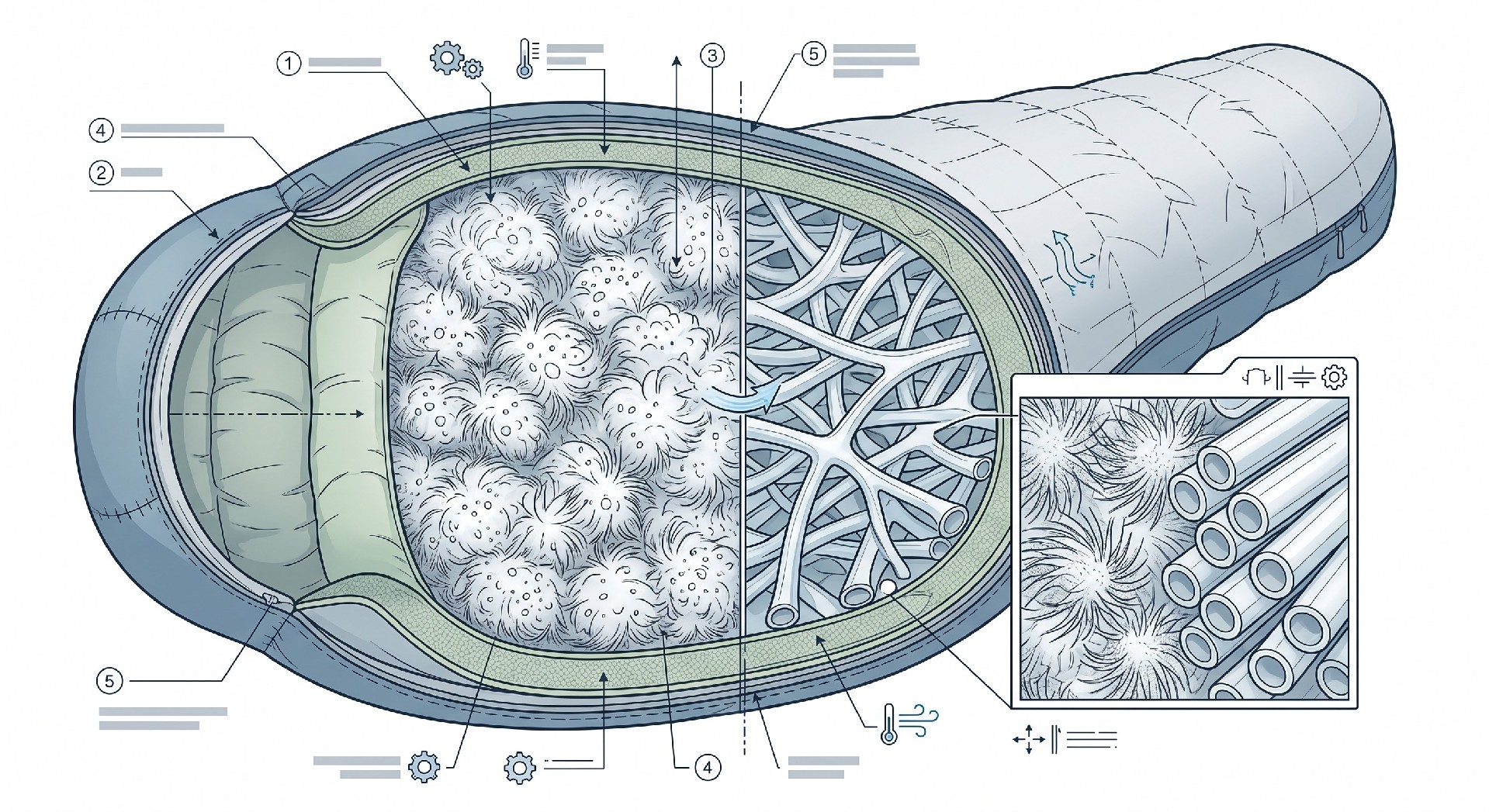
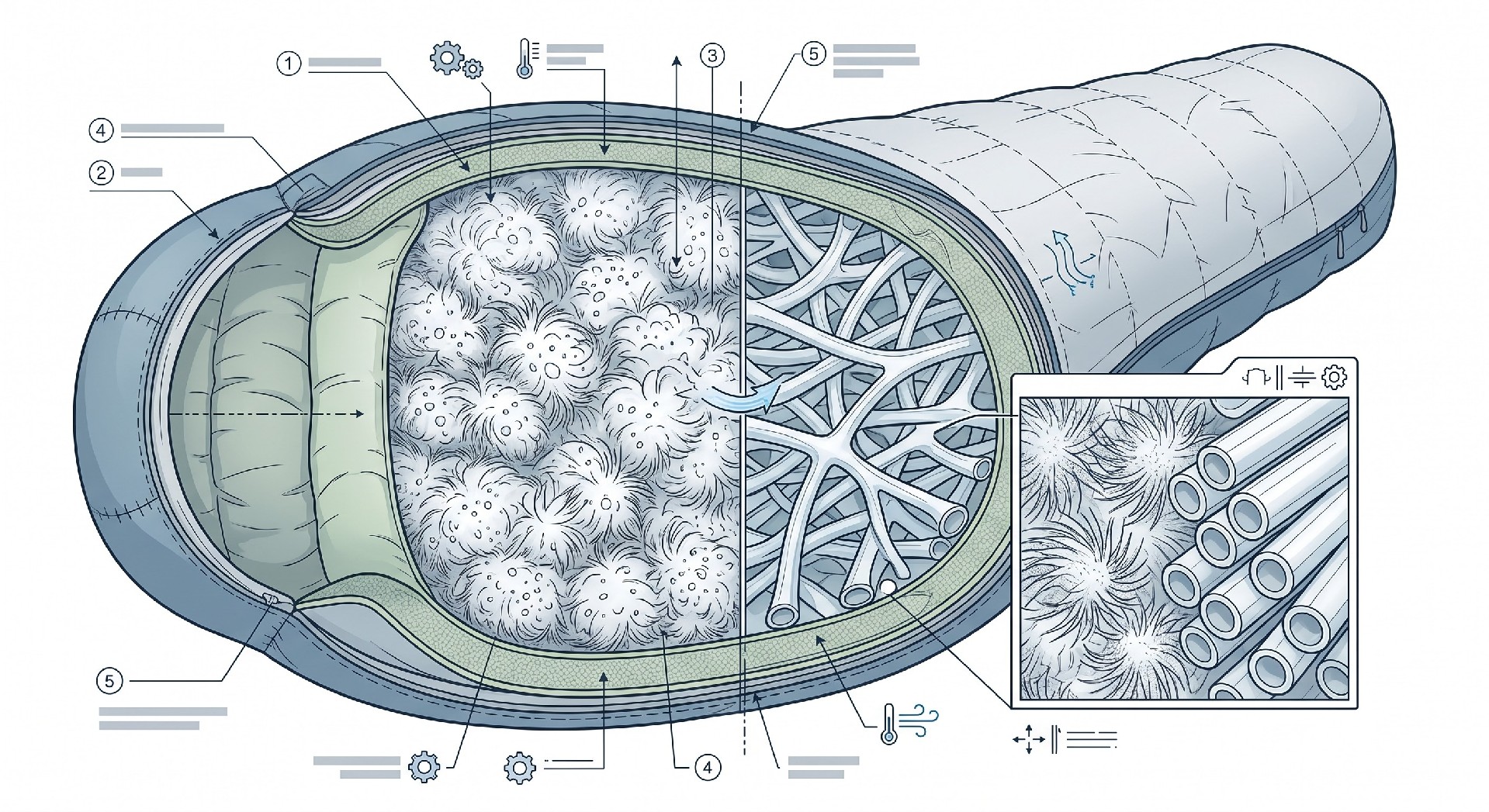
The primary function of a sleeping bag's fill is to trap dead air, creating a thermal barrier between the user and the cold environment. The fill material achieves this through its loft, or thickness, which is determined by the fill's structure and resilience. The performance of the fill is quantified by its thermal efficiency, often measured in R-value or as a temperature rating (e.g., 0°C, -10°C). For B2B buyers, understanding the engineering behind the fill is crucial for matching the product to its intended deployment.
Key Performance Metrics for Commercial Evaluation
When evaluating sleeping bag fill for commercial use, buyers should focus on these critical technical metrics:
Fill Power (Down Only): A measure of down quality, indicating the loft or fluffiness per ounce. Higher fill power (e.g., 700+ fill) traps more air and provides greater warmth for less weight but is more expensive.
Compressed Warmth: The ability to retain warmth when compressed, which is crucial for sleeping bags used by active individuals (e.g., backcountry guides).
Water Resistance: How the fill performs when wet. This is a major factor determining survival safety in unpredictable conditions.
Drying Time: The time required for the fill to return to its maximum loft and thermal performance after becoming wet.
Loft Recovery: The ability of the fill to return to its full insulating thickness after repeated compression cycles during packing and storage.
For commercial buyers, the decision often boils down to the trade-off between the lightweight, compressible, and high-warmth characteristics of down, versus the superior wet-weather performance, durability, and easier maintenance of synthetic fills.
Down Fill: Engineering for Maximum Warmth-to-Weight Ratio
Down fill is composed of the soft, fine under-feathers of ducks or geese. Its inherent structure creates thousands of tiny, interlocking filaments that trap air exceptionally well, offering the highest warmth-to-weight ratio of any insulating material. For commercial applications where weight and packability are paramount, down is the preferred choice.
Technical Advantages of Down
Unmatched Warmth-to-Weight Ratio: High-fill-power down (700+ fill) provides superior warmth with less weight, making it ideal for expeditions and long-distance treks where gear weight is a critical factor.
Exceptional Compressibility: Down can be compressed to a fraction of its size, reducing packed volume for transport and storage, a vital benefit for rental fleets with limited storage space.
Longevity: High-quality down is durable and can last for decades with proper care, offering a better long-term lifecycle cost for specialized applications.
Critical Commercial Limitations of Down
Despite its advantages, down has significant drawbacks for commercial operators, particularly in variable outdoor conditions:
Performance Loss When Wet: Down loses almost all of its insulating properties when wet, as moisture causes the filaments to clump together, destroying the air-trapping loft. This is a significant safety risk in wet or humid environments.
Slow Drying Time: A wet down bag takes a long time to dry, creating operational downtime and logistical challenges for rental fleets.
Higher Initial Cost: Premium down fill, especially high-fill-power down, commands a significantly higher price than synthetic alternatives.
Allergen Concerns: While rare, some users may have allergies to down, which is a consideration for rental operators serving diverse clientele.
| Evaluation Dimension | Down Fill | Synthetic Fill | Commercial Buyer Impact |
|---|---|---|---|
| Warmth-to-Weight Ratio | Highest (Superior, 700+ fill) | Lower (Requires more fill for same warmth) | Down: Best for weight-critical expeditions. Synthetic: Budget-friendly for heavy packs. |
| Performance When Wet | Poor (Loses up to 90% of loft) | Good (Retains 50-70% of warmth) | Synthetic: Critical for safety in wet climates. Down: Risk of user hypothermia if not managed. |
| Drying Time (After Wetting) | Very Slow (24+ hours) | Fast (4-6 hours) | Synthetic: Minimizes downtime for rental fleets. Down: Creates operational delays. |
| Durability & Lifespan | High (Can last decades with care) | Moderate (Degrades with compression/washing) | Down: Better long-term ROI for specialized use. Synthetic: Lower initial cost, but shorter life in high-use fleets. |
| Compressibility | Excellent (Packs very small) | Poor (Bulkier, larger packed volume) | Down: Reduces storage space and shipping costs. Synthetic: Increases storage and transport expenses. |
| Average Initial Cost (Commercial Bulk) | High ($150-$500+ per bag) | Lower ($40-$150 per bag) | Down: High CapEx. Synthetic: Lower CapEx, easier to replace. |
| Primary Safety Consideration | Hypothermia risk if wet | Consistent thermal protection | Synthetic: Safer choice for general, unmonitored use. Down: Requires user training for safe deployment. |
Synthetic Fill: Engineered for Durability and Dependability
Synthetic fill, typically made from polyester fibers (such as Hollofil, Thermolite, or PrimaLoft), is engineered to mimic the insulating properties of down. These hollow fibers trap air to provide warmth, but they are designed to offer greater moisture resistance. For commercial buyers prioritizing durability, maintenance, and safety in challenging conditions, synthetic fill is a robust choice.
Technical Advantages of Synthetic Fill
Retains Warmth When Wet: This is the most critical advantage. Synthetic fibers do not absorb water, so they maintain a significant portion of their insulating ability even when damp or wet, improving user safety in adverse weather.
Faster Drying Time: Synthetic fills dry much more quickly than down, which minimizes downtime for rental fleets between uses and is easier for operators to manage.
Greater Durability: Synthetic fibers are generally more robust and resistant to compression damage and moisture-related degradation than down, leading to a longer service life in high-traffic rental or institutional environments.
Lower Cost: Synthetic bags are significantly more affordable than comparable down bags, making them an attractive option for operators who need to purchase a large inventory for a rental fleet or school program.
Hypoallergenic: Synthetic fill is a safe option for users with allergies.
Engineering Tradeoffs of Synthetic Fill
Synthetic fill is not without its technical compromises, which commercial buyers must consider:
Lower Warmth-to-Weight Ratio: To achieve the same warmth as a down bag, a synthetic bag must use more fill, making it heavier and bulkier. This can be a limiting factor for backpacking or high-mobility applications.
Less Compressible: Synthetic bags do not compress as compactly as down, requiring more storage volume and leading to higher shipping costs and greater storage footprint.
Shorter Lifespan: The synthetic fibers can degrade and lose their loft over time due to repeated compression and washing cycles, leading to a shorter overall lifespan compared to premium down.
Commercial Decision Framework: Matching Fill to Your Operational Reality
The choice between synthetic and down fill for your commercial sleeping bag inventory is not about which is 'better,' but which is the right fit for your specific business model, environment, and customer base. The decision impacts CapEx, OpEx, operational efficiency, and user satisfaction.
Choosing Down Fill
Best for: Guided expeditions, high-end rental fleets (where customers value low weight), special-purpose operations (e.g., mountaineering, polar travel), and gear sold to discerning individual buyers who will prioritize maintenance.
Not ideal for: General rental fleets, youth camps, school programs, wet or humid climates, and any operation where the user is less likely to take perfect care of the gear.
Choosing Synthetic Fill
Best for: General rental fleets, camp programs, scout groups, wet or humid environments, and operations requiring highly durable, easy-to-maintain, and cost-effective equipment.
Not ideal for: Ultra-light backpacking, high-altitude expeditions where weight and pack size are critical, and operations where the absolute highest warmth-to-weight ratio is a primary marketing point.
Buyer Verification Checklist for Sleeping Bag Fill
Before placing a commercial order, procurement teams and technical managers should verify these key specification points with the supplier:
Obtain the Temperature Rating: Ensure the bag's EN or ISO temperature ratings (e.g., Comfort, Limit, and Extreme) are clearly stated. Verify with the supplier if these are based on independent tests or manufacturer estimates.
Confirm Fill Power (Down): Request official fill power test reports (e.g., from the IDFL) to validate the supplier's claims.
Assess Fill Weight: Know the total weight of the down or synthetic fill used to gauge the bag's thermal efficiency. This is a key metric for comparing products.
Request a Fabric Sample: The shell and liner fabric should be durable, breathable, and water-resistant (DWR). Verify the fabric specifications with a physical sample.
Understand the Warranty: A manufacturer's warranty is an essential indicator of their confidence in their product's durability. Warranties for down bags are often longer than for synthetics.
Review Care and Maintenance: Understand the cleaning and storage requirements for the fill. Synthetic fill is generally easier to maintain, while down requires specialized care.
Conclusion: Aligning Fill Choice with Your Operational Objectives
For commercial buyers, the sleeping bag fill decision is a strategic one. If your operation prioritizes the lowest possible weight and packed volume for high-mobility users and you can manage the cost and maintenance, choose down. However, for the majority of rental fleets, camp programs, and operations in unpredictable weather, a high-quality synthetic fill offers the superior combination of durability, safety, and value for money. Ultimately, the right choice is the one that provides your clients with a safe, comfortable experience while aligning with your financial and operational goals.
