

Why Standard Daypacks Fail on Multi-Day Hikes—and What to Look For
The decision between a lightweight outdoor handbag and a traditional backpack is often the first point of friction for hikers transitioning to long-distance trails. Standard daypacks, designed for short excursions, typically lack the structural support, hip-belt load transfer, and volume flexibility required for multi-day food and gear carries. A lightweight outdoor handbag for long-distance hiking must solve three core problems: distributing a 10–15 kg total pack weight efficiently, protecting sensitive gear from trail abrasion and weather, and providing rapid access to navigation, hydration, and layers without fully removing the pack. For commercial buyers—whether outfitting guide teams, reselling to serious amateur hikers, or supplying expedition rental fleets—the specification choices made at the purchase stage directly affect client comfort, equipment lifespan, and liability exposure.
Defining the Hike Profile: Terrain, Duration, and Load
Before comparing materials or pockets, define the intended use case. Long-distance hiking typically spans 4–14 days between resupply points, with daily distances of 20–40 km over mixed terrain. This places demands on the handbag that differ sharply from peak-bagging or hut-to-hut travel. Three primary variables determine the optimal specification:
Total carried weight: A base weight (pack + shelter + sleep system + cook kit) of 4–6 kg plus food and water for 3–5 days often results in a total load of 10–15 kg. The handbag's frame, hip belt, and shoulder straps must be rated for this range without excessive flex.
Volume requirement: For a 7-day unsupported hike, a volume of 50–65 liters is a common commercial target, though some ultralight setups compress to 40–45 liters.
Terrain and climate: Rocky, overgrown, or wet trails demand higher abrasion resistance and faster drying times. Cold or variable conditions require additional volume for insulating layers and rain gear.
For rental fleets, these variables translate directly into inventory decisions: a single pack model cannot cover all profiles. Commercial buyers often select two volume tiers—typically 45 L and 60 L—and one lightweight frame configuration that balances load transfer and pack weight.
Frame Architecture and Load Transfer Mechanisms
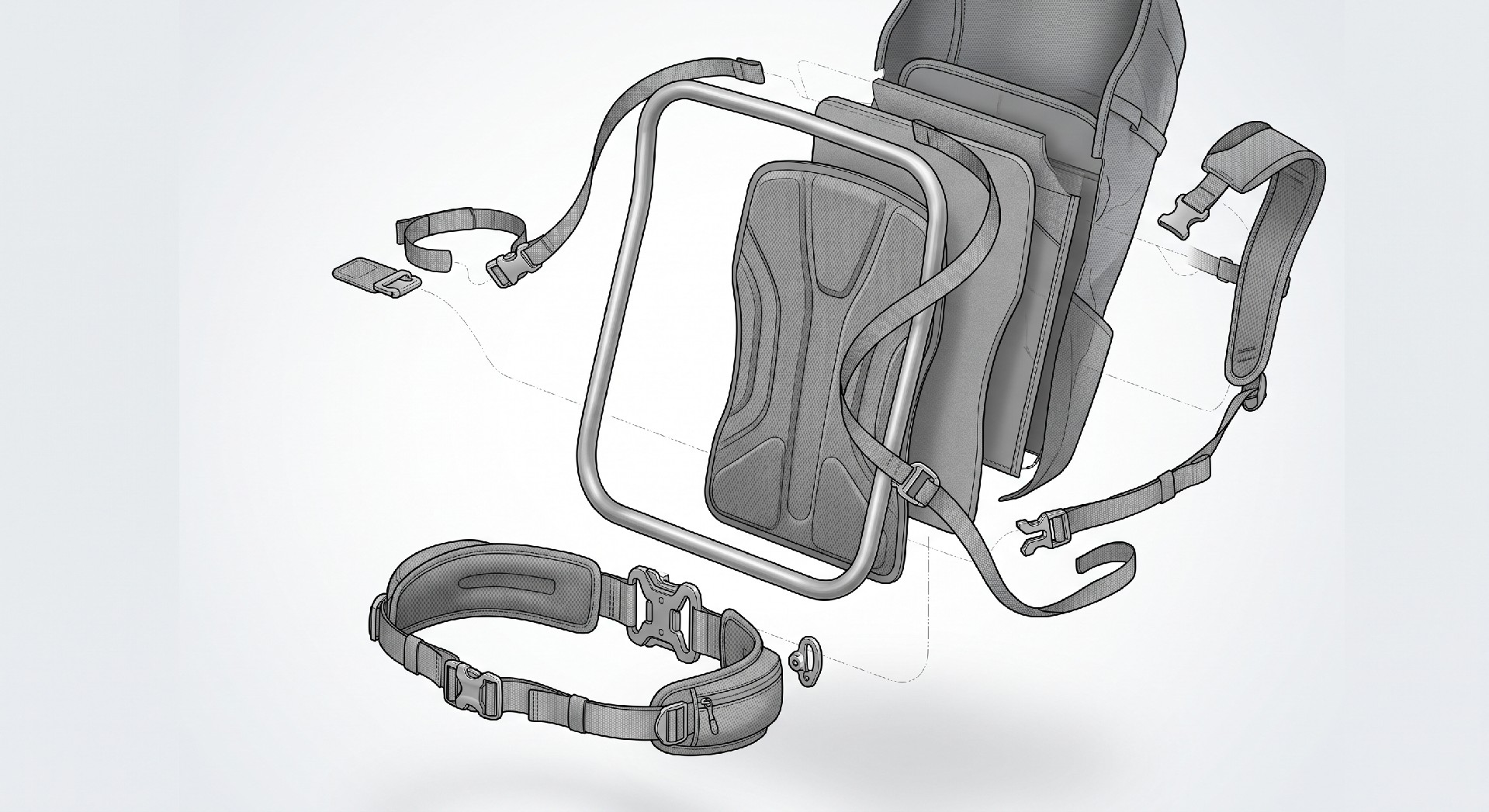
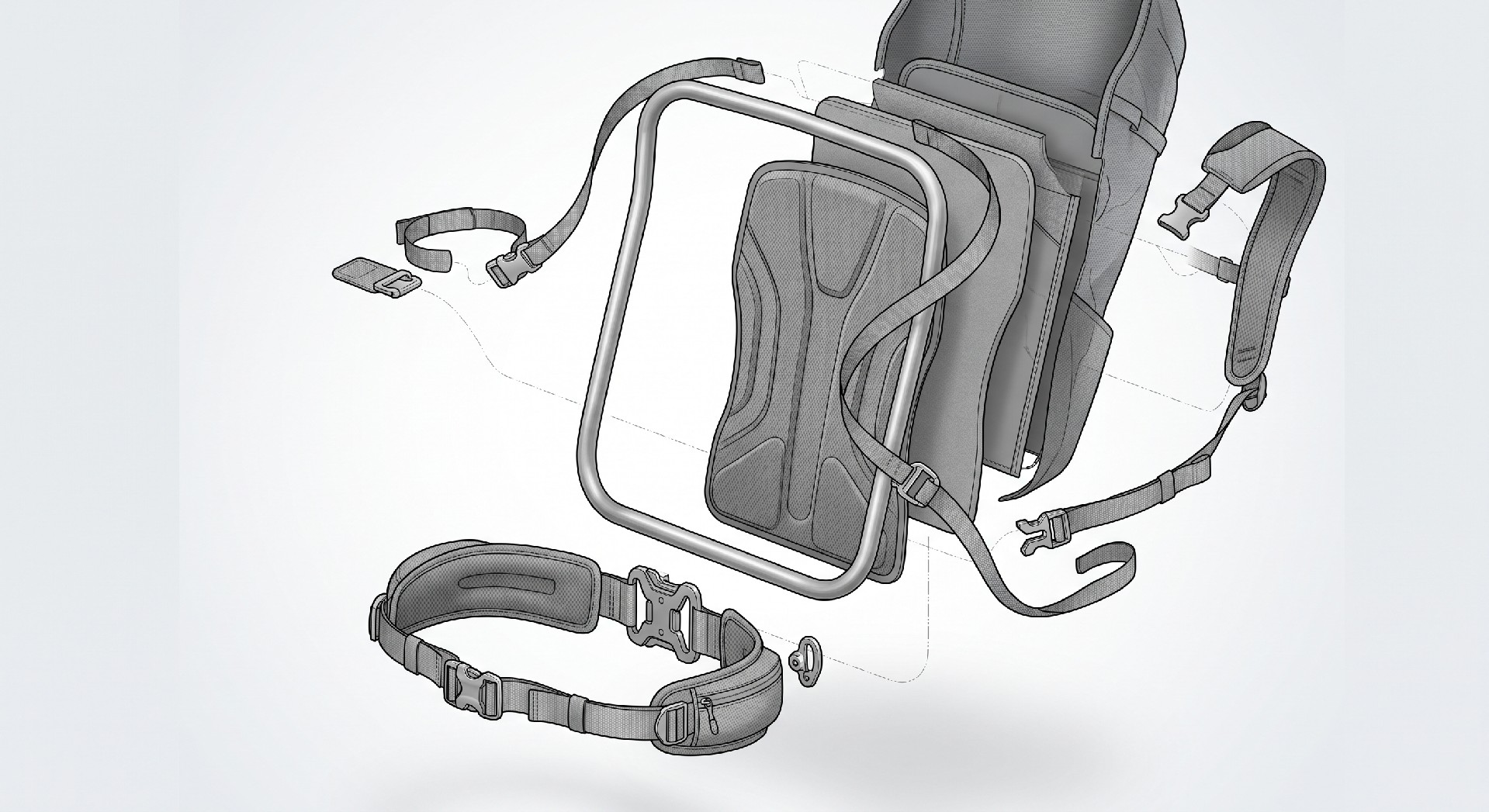
The most overlooked specification in lightweight outdoor handbags is the frame system. In traditional backpacking, an internal frame—either a peripheral hoop, stay, or sheet—transfers load from the shoulder straps to the hip belt. In lightweight handbags, frame designs fall into three commercial categories:
Frameless: Rely on packing technique and a foam back panel. Suitable for base weights under 6 kg and total loads under 10 kg. Common for fastpacking and ultralight specialists but less appropriate for general long-distance use.
Peripheral frame (hoop or U-shaped stay): Uses a single aluminum or composite stay that wraps around the pack's perimeter. Offers good load transfer to the hip belt while keeping pack weight low (850–1,100 g).
Dual-stay or frame-sheet hybrid: Two vertical stays combined with a molded foam sheet. Provides the best load transfer for 15+ kg loads but adds 150–250 g of additional weight.
For long-distance hiking, the peripheral frame or hybrid designs dominate the commercial lightweight segment. A key buyer decision point is the stiffness of the hip belt connection: does the frame have a load-lifter strap that adjusts the angle between the shoulder strap and the pack body? This feature—often absent in budget-oriented designs—directly impacts comfort on day 3 and later, when shoulder fatigue begins to accumulate.
Fabric Selection and Abrasion-Resistance Tradeoffs
Fabric choices in lightweight outdoor handbags represent a classic commercial tradeoff: weight, durability, cost, and water resistance. The three most common fabrics specified by OEMs and evaluated by commercial buyers are:
Nylon 6.6 (Cordura or proprietary variants) in 100–210 denier: The industry standard for lightweight packs. 100D offers a weight saving of 10–15% compared to 210D but reduces abrasion resistance by approximately 20–30% in controlled Wyzenbeek testing. For long-distance hiking on maintained trails, 210D is often specified for the main body, with heavier 330–420D panels on the base and side pockets where ground contact occurs.
Robic nylon (high-tenacity variant): Offers improved abrasion resistance relative to standard nylon of equal denier but typically commands a 15–20% price premium at the fabric stage. Often specified by OEMs targeting premium or guide-oriented product lines.
Polyester blends (e.g., 150D–250D): Lower cost and superior UV resistance compared to nylon, but generally lower tear strength and abrasion performance. More common in budget-oriented lines or products intended for occasional use.
For commercial buyers, the decision often centers on the minimum tear strength in the base and side panels, as these zones experience repeated contact with rocks, tree roots, and ground surfaces during rest breaks. A typical commercial target is 120–150 N tear strength (ASTM D2261) for the body and 180–200 N for the base, depending on the intended trail conditions.
Volume, Access, and Organization: Commercial Configuration Options
The volume and access configuration of a lightweight outdoor handbag directly influences packing efficiency, on-trail organization, and client satisfaction in commercial settings. While the total volume is often the primary advertised number, the effective usable volume after compression and pocket allocation is the critical metric for buyers. Common commercial configurations include:
Top-loading with a floating lid: The traditional design for long-distance packs. Offers the best weight-to-volume efficiency but requires careful organization of frequently used items.
Front-loading (U-zip or panel access): Allows full access to the pack's interior without unloading all gear. Adds 100–150 g for the zipper and reinforcement, but significantly improves user convenience, especially in rental fleets where multiple users repack daily.
Pocket layout: Hip-belt pockets for snacks and navigation, shoulder-strap pockets for a phone or water bottle, and a large front mesh or lycra pocket for wet or quick-access gear. Commercial buyers should verify that hip-belt pockets are removable or positioned to avoid chafing during long strides.
A specific commercial concern is the hydration sleeve and hose routing. While almost all packs include a sleeve, the routing path often causes hose kinking or interference with sternum strap adjusters. Models with a dedicated, centered exit port and a magnetic hose retention system are increasingly requested by outfitters for ease of use.
| Specification Area | Recommended Target for Long-Distance Hiking | Common Commercial Range | Buyer Verification Method |
|---|---|---|---|
| Volume (main compartment) | 50–60 liters (for 7-day unsupported) | 45–65 liters depending on duration | Request packed and deployed volume measurements. |
| Pack weight (empty) | 900–1,200 g | 750–1,500 g depending on frame and fabric | Weigh sample on a certified scale. |
| Fabric type (body / base) | 210D nylon / 330D nylon | 100D–420D nylon or Robic variants | Verify tear strength (ASTM D2261) from supplier. |
| Frame type | Peripheral hoop or dual-stay | Frameless to full internal frame | Inspect hip belt connection and load-lifter adjusters. |
| Hip belt rated load | 15 kg comfort load | 10–18 kg depending on design | Check buckle and padding design; test under load. |
| Zipper size (main) | #5 or #8 | #3 to #10 | Test for smooth operation under tension and with grit. |
| Warranty / service life | 5–7 years with 150 days/year usage | 3–10 years depending on quality tier | Review warranty claim rate and field test data. |
Hardware, Zippers, and Adjuster Quality: The Weak Points
In commercial field surveys, zipper and buckle failure is the most frequent non-catastrophic warranty claim for lightweight handbags. For long-distance hiking, the stress on zippers is amplified by repeated opening/closing for food, shelter, and clothing access, often with grit or dust contamination. Key hardware specifications to verify include:
Zipper size: #5 zippers on main compartments and #8 zippers on high-stress pockets are common commercial specifications. #3 zippers are often used on internal pockets but should be avoided on load-bearing or external-access points.
Buckle material: Polyacetal (POM) and nylon buckles are standard. The critical metric is the webbing-to-buckle engagement: a 30–40 mm webbing width with a matching buckle reduces slippage and failure risk under load. Buyers should test the buckle release force—too easy means accidental opening, too hard means user frustration in cold conditions.
Adjuster hardware (ladder locks, triglides): Metal adjusters are heavier but offer more consistent grip over time compared to plastic variants, which can wear and slip under repeated load cycling.
Weather Protection: Water-Resistant Fabrics vs. Integrated Rain Covers
Most lightweight outdoor handbags for long-distance hiking are sold as water-resistant, not waterproof, due to the impossibility of sealing every seam and closure against sustained rain. Commercial buyers face a choice between relying on the fabric's DWR (durable water repellent) coating plus a separately purchased rain cover, or specifying a pack with an integrated, removable rain cover stored in a base pocket.
For rental fleets, integrated covers reduce loss of ancillary items but add 80–120 g and require regular inspection for seam delamination at the cover attachment points. For private-label brands, offering a dry bag-style roll-top closure on the main compartment can provide higher water resistance without the weight penalty of a cover—provided the roll-top design does not compromise access convenience. The commercial decision often hinges on the expected hike climate: high-rainfall regions (e.g., Pacific Northwest, UK, Alpine foothills) tend to favor integrated covers, while arid or high-altitude routes may prioritize lighter, simpler fabric treatments.
Weight, Packability, and Shipping Considerations
While the article focuses on lightweight handbags, commercial buyers must also consider packed volume for shipping and storage. A lightweight handbag that compresses to a smaller cube reduces freight costs and warehouse footprint, directly affecting per-unit logistics expense. OEM specifications often quote a packed size—typically 25–30% of the deployed volume—but buyers should verify this under realistic conditions: empty, the pack should fold flat or roll into a compact bundle without damage to the frame stays.
For multi-unit orders, the packing configuration (individual polybags vs. bulk cartons) and the included accessories—such as the rain cover, repair kit, and attachment straps—affect both landed cost and unpacking labor. Commercial buyers should request a dimensional weight certificate for the packed sample, as this metric can shift the shipping cost class by 10–20% for containerized orders.
Durability Testing and Warranty Expectations
In the lightweight equipment segment, commercial warranties typically fall into two models: a limited lifetime warranty covering manufacturing defects (common for brands positioning at the premium end) and a 1- to 3-year workmanship warranty (standard for mid-tier products sold through wholesale channels). For a lightweight outdoor handbag used on a 4,000 km thru-hike, the critical failure points observed in field returns are:
Shoulder strap padding delamination and foam compression (typically after 2,500–4,000 km of use).
Hip belt buckle fracture under repeated 10+ kg load cycles.
Seam tape delamination on internal seams where moisture accumulates.
For buyers, a warranty claim rate of 0.5–1.5% per year of field use is a common commercial benchmark for well-designed lightweight handbags. Rates exceeding 2.5% often indicate material specification issues or production quality inconsistencies that should be escalated to the supplier. To validate durability before large orders, commercial buyers should request test results from a pull-slide cycling test (simulating zipper use) and a drop-load test (simulating the pack being dropped from waist height with a 10 kg load).
Buyer Decision Matrix: Volume, Frame, and Material
For commercial buyers evaluating lightweight outdoor handbags for long-distance hiking, the final decision should be based on a three-dimensional tradeoff: the required volume and load capacity, the desired pack weight, and the budget threshold. The following sequence provides a practical procurement framework:
Define the maximum food and water carry for the intended trail length. A 7-day unsupported route with 2 L water carry often requires 55–60 L total volume; a 4-day route with reliable water sources may fit in 45–50 L.
Select the frame type based on the expected total pack weight. Under 10 kg, frameless designs are viable; 10–15 kg requires a peripheral frame; over 15 kg is better served by a dual-stay or framed design, even if it adds 200–300 g.
Choose fabric and hardware grades based on trail conditions and expected lifespan. For commercial fleets with high turnover (e.g., guided trips), 210D nylon body and 330D base panels strike a balance between durability and cost. For premium private-label products, Robic nylon with #8 zippers and metal adjusters may be specified.
Avoid specifying a lightweight handbag solely on the advertised weight metric. A 750 g pack that lacks a supportive hip belt and uses 70D fabric will degrade comfort and durability, increasing client complaints and shortening the replacement cycle. The commercially optimal lightweight handbag typically weighs 900–1,200 g, uses 210D–330D nylon in abrasion zones, includes a peripheral frame with load-lifter straps, and has a hip belt rated for at least 15 kg comfort load. This configuration provides a 5–7 year service life in a rental operation with annual usage of 150 days and can be offered at a retail price point of USD 180–280, depending on the brand and accessory inclusions.
In summary, selecting a lightweight outdoor handbag for long-distance hiking requires prioritizing load transfer and abrasion resistance over minimal pack weight, and specifying hardware and fabric grades that match the intended trail environment and commercial usage pattern. By applying the framework outlined above, commercial buyers can confidently choose a product that meets both hiker expectations and operational durability requirements.
