

The Real Cost of a Fishhook Puncture in a Commercial Fleet
For a rental operation, a single fishhook puncture in an inflatable boat hull rarely sinks the vessel, but it consistently sinks the day's revenue. The real search intent behind "How to Avoid Fishhooks Puncturing Your Inflatable Boat Hull" is not just about patching a hole; it is about maintaining fleet availability, controlling unpredictable maintenance costs, and preserving the structural integrity of a high-value commercial asset. Unlike a slow leak from a seam, a hook puncture is an acute, field-level failure that forces an immediate boat rotation, frustrates customers, and creates a recurring labor burden for your dock staff. This guide is written for rental fleet operators and resort buyers who need a practical, specification-driven protocol to minimize hook-related downtime, from material selection to on-water operating procedures.
Why the Classic Patch Kit Is Not a Sufficient Strategy
Relying solely on a field repair kit as your primary defense against fishhooks is a reactive, high-cost approach. While a PVC patch can seal a small hole, the real commercial losses accrue from the unscheduled downtime: the boat must be taken out of service, inspected, dried, patched, and cured—often for 24 to 48 hours in humid conditions. For a fleet of 10 boats, losing one unit per week to a hook puncture translates to a 10% reduction in rental capacity during peak seasons. Furthermore, repeated patching in the same area, especially near high-stress zones like the tube-to-floor junction, can compromise the hull's structural rigidity. A proactive strategy, therefore, focuses on prevention and rapid, durable repair protocols that minimize out-of-service time.
Material Selection as Your First Line of Defense
The hull material's resistance to punctures is not solely defined by its thickness. The key variables are tensile strength, tear resistance (often measured by the Trouser Tear method), and abrasion resistance. In the commercial inflatable boat market, you will typically encounter three primary constructions:
PVC (Polyvinyl Chloride): The most common and cost-effective option. In a typical commercial range of 0.9mm to 1.2mm thickness, PVC offers good abrasion resistance but can be more susceptible to punctures from sharp, fine points like a hook's barb compared to some coated fabrics. Its repairability is excellent, but the repair area must be absolutely clean and dry for the adhesive to bond effectively.
CSM (Chlorosulfonated Polyethylene) / Hypalon: This synthetic rubber offers superior resistance to UV, ozone, and chemicals. More critically for this topic, its higher tear strength and elasticity mean that a hook point often displaces the fabric rather than cleanly piercing it. A Hypalon hull is more forgiving in a fishing environment. However, it is significantly more expensive and requires more specialized adhesive systems for repair.
High-Density Drop-Stitch: While primarily used for floors and keels, drop-stitch construction is extremely puncture-resistant due to the high-density inner core. A fishhook is unlikely to penetrate a properly inflated drop-stitch floor, making it an excellent choice for fishing boats where anglers are standing and casting.
For a rental fleet operating in waters with high fishing pressure, specifying a CSM hull or a drop-stitch floor is a commercial decision that significantly reduces the puncture incident rate.
Understanding the Puncture Mechanism
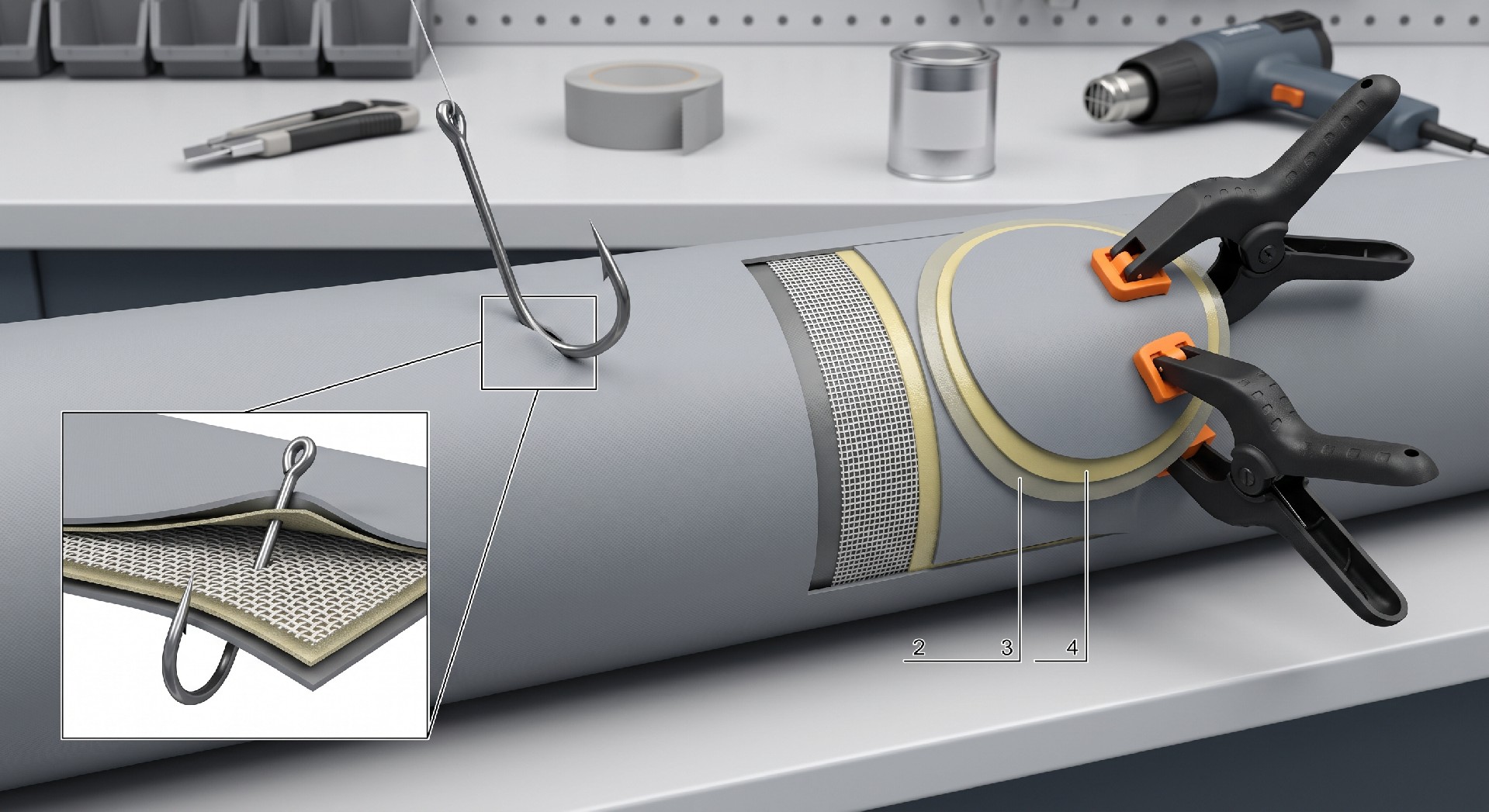
A fishhook does not simply stab the boat; it often embeds and then tears as the line is pulled or the fish fights. The barb creates a tearing action that can turn a 2mm puncture into a 10mm tear. The most vulnerable areas are the tubes, where the fabric is under the highest tension from internal air pressure (typically 3.5 to 4.5 PSI for recreational boats) and the seam overlaps, where the adhesive layer can be compromised by a tear. This is why simply pulling the hook out is the worst possible action.
| Hull Material | Puncture Resistance | Repair Complexity | Best Fleet Use Case |
|---|---|---|---|
| Standard PVC (0.9mm) | Moderate; susceptible to fine point punctures. | Simple; requires cleaning and standard PVC adhesive. Cure time 24 hrs. | Calm water rentals, low fishing pressure, budget-conscious fleets. |
| Heavy-Duty PVC (1.2mm+ with scrim) | Good; thicker fabric reduces penetration risk. | Moderate; requires more adhesive due to fabric weight. | General purpose rentals, moderate fishing activity, good value-for-money. |
| CSM (Hypalon) | Excellent; high elasticity and tear strength resist hook points. | Complex; requires specialized two-part neoprene adhesive and longer curing. | High-end rental fleets, saltwater environments, heavy fishing use, premium resorts. |
| Drop-Stitch Floor | Extremely High; dense inner core prevents penetration. | Not applicable to floor; patching is similar to tube material. | Essential for fishing boats to protect the floor from dropped hooks and gear. |
Operational Protocols: Reducing the Risk On-Water
Beyond material choice, the most effective prevention is operational discipline. This involves clear communication with customers and well-defined operating rules.
Clear Customer Briefing: Before launching, every renter must be verbally briefed on hook handling. The rule is simple: do not cast near the boat. Anglers should be instructed to cast away from the hull, and if a fish is hooked near the boat, they should net it rather than swinging it aboard, which can cause the hook to fly loose.
Designated Tackle Zones: In larger boats (e.g., 4.5m+), designate a specific area for baiting hooks and storing tackle. This confines the sharp objects to a zone where the floor (preferably drop-stitch) is protected.
Barbless Hooks: For rental operations, implementing a policy of using barbless hooks or pinching the barbs down is a game-changer. A barbless hook is significantly easier and safer to remove from fabric, causing a clean, small puncture rather than a tearing wound to the boat.
Immediate Action Protocol: If a hook does puncture the hull, the renter must not pull it out. The immediate action is to deflate the chamber slightly to reduce tension on the fabric, then cut the line and tape the hook down to prevent further tearing.
Rapid Repair: The Fleet Operator's Puncture Response
When a puncture occurs, the speed and quality of the repair determines your fleet's availability. This goes beyond the typical owner's manual patch.
The Professional Repair Standard
For a commercial fleet, the goal is a repair that is stronger than the original fabric. This is achieved through a three-step process:
Drying and Preparation: The boat must be fully dry. Moisture is the enemy of adhesive bonding. The area around the puncture should be cleaned with a solvent (like MEK for PVC) to remove all dirt, grease, and surface treatment.
Patch Design: The patch should be circular or oval with rounded corners to prevent peeling. It should overlap the puncture by at least 50mm in all directions. For a tear, the patch must be larger, extending 75mm beyond the end of the tear.
Adhesive and Clamping: Use the correct adhesive for the hull material. For PVC, a two-part solvent-based adhesive is standard. Apply two coats, allowing each to tack off. For CSM, a specific neoprene-based adhesive is required. Once the patch is applied, it must be clamped or rolled with a seam roller to ensure full contact and eliminate air bubbles. The cure time is critical; do not inflate the boat for at least 24 hours to allow the adhesive to reach full strength.
For a fleet, maintaining a dedicated repair station with a controlled environment and a stock of pre-cut patches in various sizes can turn a 24-hour downtime into an overnight fix.
[IMAGE_2]
Fleet Decision: Proactive Replacement vs. Reactive Patching
The final commercial decision is knowing when to stop repairing a hull. A boat that has accumulated more than 10 significant patches, or has a patch in a critical structural seam, should be considered for retirement or repurposed as a non-revenue training boat. The life cycle cost of a hull is not just the purchase price; it is the revenue it generates minus the cost of downtime and repairs. By proactively investing in high-abrasion/tear-resistant materials (like CSM) and implementing strict on-water protocols, a fleet operator can reduce puncture-related downtime by over 60%. The choice is clear: invest in prevention and professional repair, or pay for the constant disruption of reactive patching. For a resort or rental buyer, specifying a hull with a reinforced rubbing strake and a drop-stitch floor is a specification that directly pays for itself within the first operational season.
