

Introduction: The Critical Role of Seam Integrity in Commercial Inflatables
For B2B procurement specialists and commercial fleet operators, the longevity and safety of inflatable assets—from white-water rafts to luxury resort docks—are non-negotiable. While fabric denier and valve quality are often discussed, industry data consistently points to the seam as the primary point of failure in commercial inflatables. The choice between glued, stitched, and welded seams defines the total cost of ownership (TCO) and operational reliability of your equipment. This guide provides a technical deep-dive into double-seam welding, exploring the engineering, materials, and ROI implications for high-performance commercial environments. We will analyze why modern hot-air and RF welding technologies have become the gold standard for drop-stitch and high-pressure inflatables, offering superior strength compared to traditional adhesives.
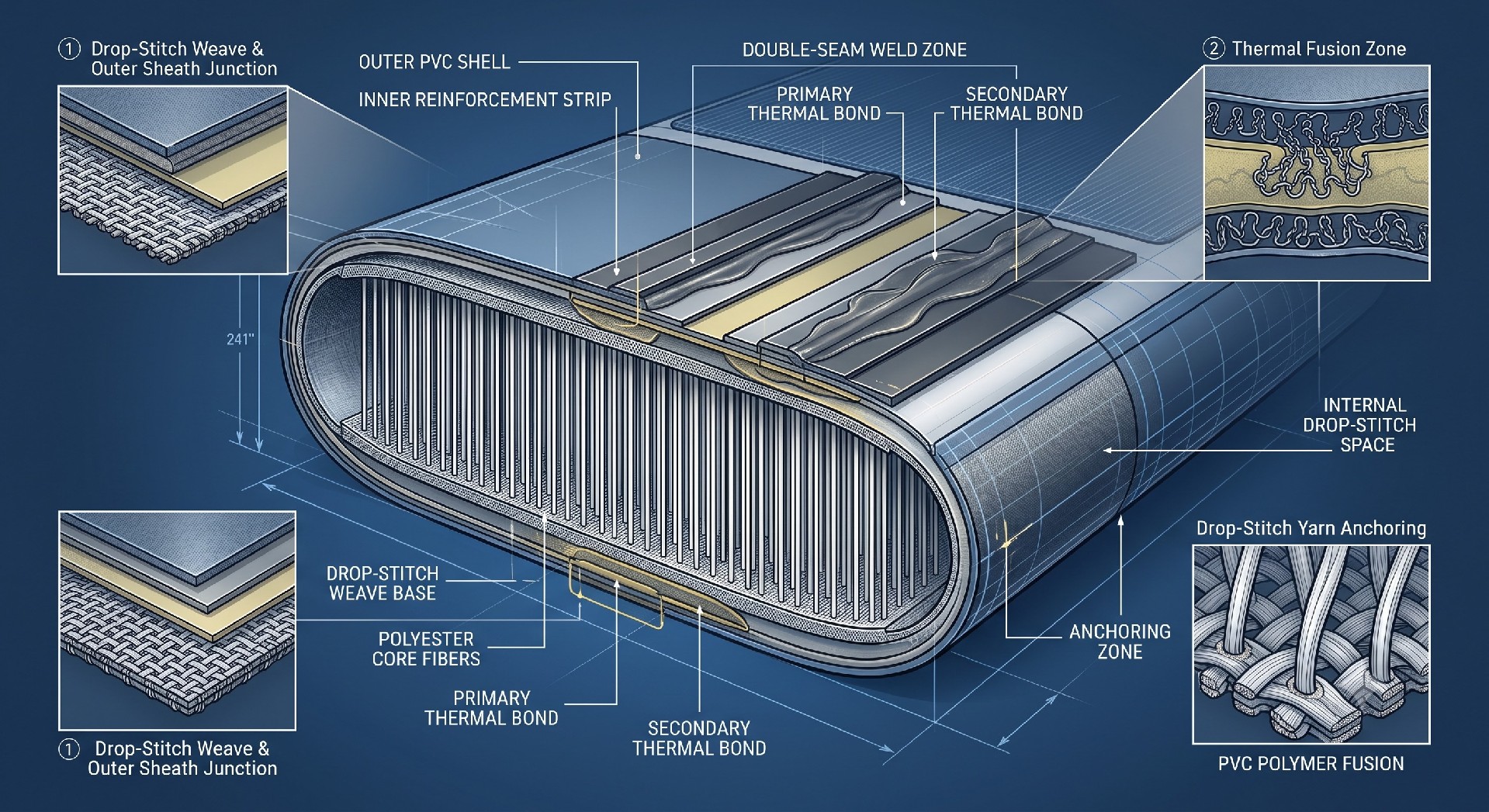
Material Science: PVC, Hypalon, and the Drop-Stitch Core
The performance of any welded seam begins with the substrate. In commercial inflatables, two materials dominate: PVC (Polyvinyl Chloride) and Hypalon (CSM). PVC-coated fabrics are highly favored for commercial production due to their ability to be thermally welded using high-frequency (RF) or hot-air processes, creating a homogenous, molecular bond that is as strong as the material itself. This is essential for drop-stitch technology, where thousands of polyester threads connect two fabric panels. When inflated to pressures between 10-15 PSI, this construction creates a rigid, structural surface capable of supporting significant loads.
Comparative Analysis: Welded vs. Glued Seams
While Hypalon seams are typically glued—a labor-intensive process that, when done correctly, creates a strong bond—they are susceptible to degradation over time due to UV exposure and chemical breakdown. Conversely, welded PVC seams offer a distinct advantage: the seam is airtight without the risk of adhesive weakening. This is critical in commercial settings where equipment undergoes constant inflation and deflation cycles. Studies on inflatable costumes and marine gear indicate that welded seams have a 95% survival rate after two years of heavy use, compared to significantly higher failure rates in stitched-only or glued alternatives.
The Engineering of Double-Seam Welding
Double-seam welding refers to the application of two separate weld passes or the utilization of a specific welding technique (like hot air or RF) combined with structural reinforcement to ensure maximum integrity. The process typically involves joining two coated fabric panels using heat and pressure, causing the polymer coatings to flow together and form a permanent bond.
Welding Methodologies: RF vs. Hot Air
RF (Radio Frequency) welding is ideal for PVC, using electromagnetic energy to generate heat precisely within the material, creating consistent, aesthetically pleasing seams. In contrast, hot air welding involves blowing a stream of heated air (often controlled to exact temperatures via PLC/HMI systems) between the fabric layers, bonding them under pressure. For complex double-wall/drop-stitch materials, advanced hot air machines like the T300 Extreme Curve are designed to ensure uniform heat application and consistent seam bonding, a requirement for achieving airtight seams without weak spots.
Parameter Precision: Pressure, Heat, and Speed
Consistency is key. Automated welding systems provide precise control over the heating nozzle, pressure rollers, and feed speed. This prevents common issues like material misalignment or inadequate pressure, which lead to weak bonds. For high-strength commercial applications (e.g., rescue boats and military shelters), the seam's bond strength is often tested to ensure the fabric fails before the seam does—a benchmark of superior manufacturing quality.
| Key Parameter | Technical Specification |
|---|---|
| Material Thickness (Typical) | 0.9mm / 1100D Reinforced PVC or 0.9mm CSM (Hypalon) |
| Welding Technology | Hot Air (150-200°C) or Radio Frequency (RF) |
| Drop-Stitch Core Height | 4-inch to 6-inch (Common for iSUPs and Water Mats) |
| Maximum Recommended PSI | 10-15 PSI (Standard); Up to 50 PSI for Specialized Airbeams |
| Seam Strength Benchmark | Fabric fails before the weld (Meets ISO 6185 Standards) |
| Average Lifespan (Heavy Use) | 5-7+ Years (vs. 2-3 years for glued alternatives) |
Seam Strength and Stress Distribution
For high-performance inflatables like aerostats or heavy-load watercraft, stress concentrations at the seam are a primary design concern. The maximum load on an inflated structure often occurs at its widest diameter, necessitating a seam design that distributes mechanical stresses effectively. Single, un-reinforced seams can suffer from stress concentration under payload, leading to material fatigue. A robust double-seam or reinforced seam (e.g., a double strap overlap) can distribute this load over a larger area, ensuring the joint's failure point exceeds the fabric's tensile strength. This aligns with airship design criteria requiring safety factors of up to 4:1, emphasizing the need for welds that can withstand significant environmental and mechanical stress.
Commercial Use Cases and ROI Analysis
Implementing double-seam welding directly impacts the bottom line. For rental fleets (paddle boards, water mats, and inflatable docks), the durability of the seam dictates the equipment's lifespan. High-quality welds reduce downtime for repairs, a significant cost driver in high-turnover rental operations. Unlike glued seams that degrade, welded seams maintain their integrity, reducing landfill waste and enhancing the brand's sustainability profile.
Safety and Compliance Standards
For commercial operations, safety is paramount. Welded seams are the standard for critical safety equipment like life vests, emergency evacuation slides, and white-water rafts. Compliance with international standards such as ISO 6185 (for inflatable boats) and EN71 (for toys and recreational use) often hinges on seam strength. Double-seam welding demonstrates a commitment to these stringent safety protocols, mitigating liability and ensuring end-user protection.
[IMAGE_2]
Conclusion: The Strategic Advantage of Superior Welding
For B2B buyers, double-seam welding is not just a manufacturing detail; it is a critical performance indicator for long-term commercial success. It reduces the total cost of ownership through enhanced durability, increases safety, and ensures compliance with global safety standards. When sourcing commercial inflatables, prioritize manufacturers who utilize advanced hot air or RF welding technology and provide detailed specifications on their seam construction, material thickness (e.g., 0.9mm / 1100D PVC), and pressure capacity. Investing in superior seam technology is an investment in operational efficiency, safety, and brand reputation.
