

Introduction: The Strategic Imperative of Modern Fireboat Fleets
For municipal procurement officers and commercial fleet managers operating in dense coastal or riverside environments, the deployment of a firefighting boat represents a critical intersection of public safety, high-stakes capital expenditure, and logistical complexity. Unlike standard marine vessels, a fireboat in an urban waterfront setting is a mobile command center, a high-capacity pump station, and a rapid rescue platform. The modern shift towards specialized, high-performance fireboats—craft that must navigate shallow marinas while delivering firefighting capabilities comparable to land-based engines—is driven by increasing population density along waterways and a surge in maritime tourism .
This guide provides a comprehensive B2B technical analysis of what constitutes an effective urban fireboat. We move beyond simple specifications to examine material science, propulsion dynamics, and the operational ROI that defines a successful procurement.
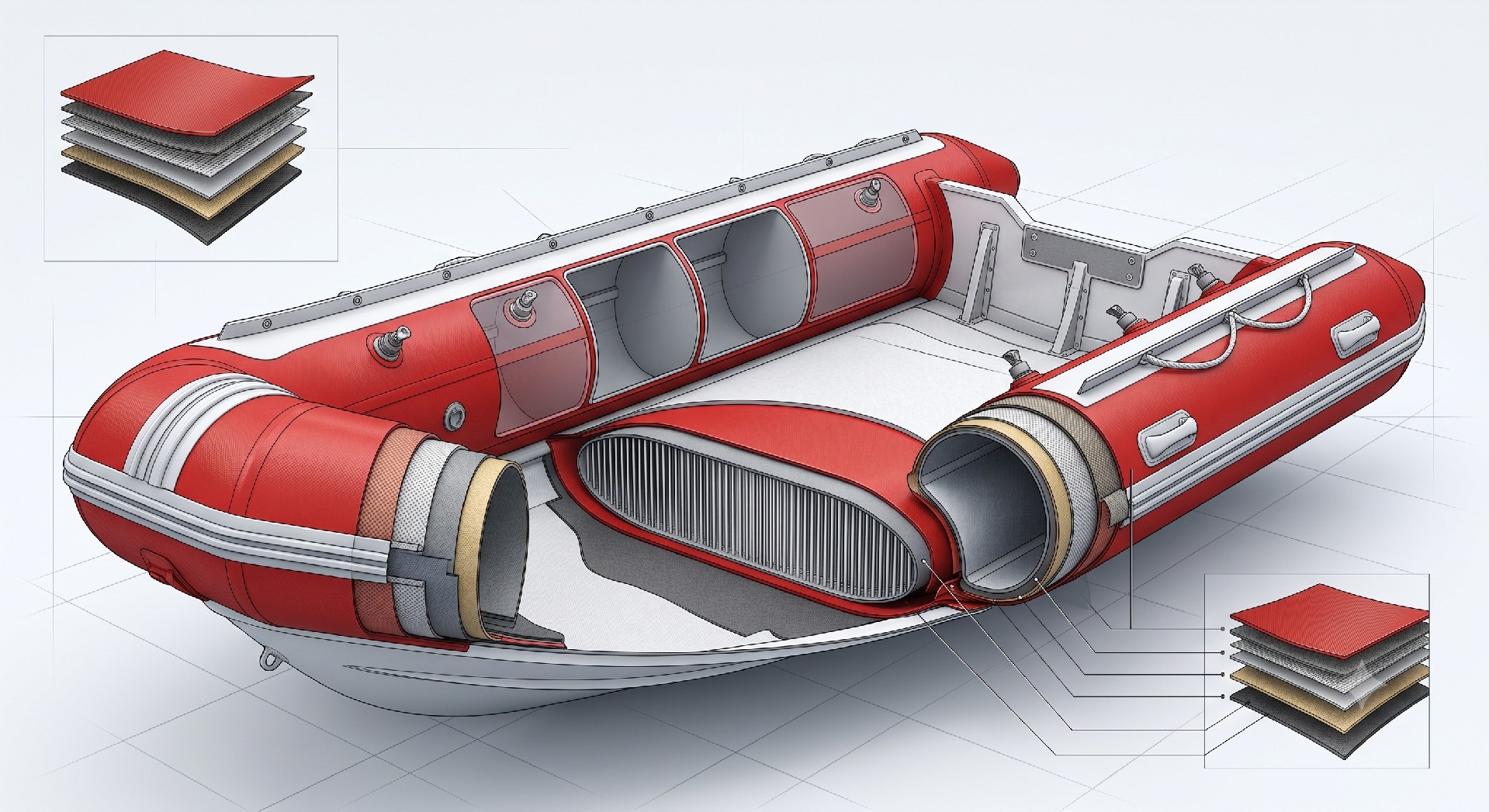
Material Science and Core Engineering: Defining Urban Survivability
The selection of materials for a fireboat operating in confined, high-traffic waterways is a non-negotiable factor in its deployment lifecycle. While traditional hard-shell aluminum (e.g., 5083 marine-grade alloy) remains prevalent for large vessels due to its structural rigidity , modern urban fleets increasingly deploy high-performance inflatable or rigid-hull inflatable boats (RHIBs) for agility.
Hypalon vs. PVC: The Fabric Debate
For rescue and rapid response vessels operating in shallow rivers and marinas, the fabric of the inflatable structure is paramount. Professional-grade military and fire rescue specifications often mandate Hypalon/Neoprene (CSM) fabric. According to Zodiac MilPro technical data, the MK3 GR series utilizes a 940 dtx polyamide support coated with Hypalon neoprene .
UV and Ozone Resistance: Hypalon offers superior resistance to UV degradation and ozone cracking compared to standard PVC, a critical factor for vessels moored outdoors in urban harbors.
Material Thickness: While specific thicknesses vary, commercial-grade fabrics typically start at 0.9mm for 1100D PVC; however, high-end systems like the 1880 dtx (denier) fabrics used in the SRR420 series represent the upper tier of durability, designed for high-pressure operations and impact resistance .
Drop-Stitch and Pressure Dynamics
For craft requiring exceptional rigidity without a rigid hull, Drop-Stitch technology allows for inflation pressures up to 0.24 bar (3.4 psi) . This creates a rigid floor structure capable of supporting heavy outboard engines and emergency payloads.
Deployment Logistics and Urban Navigation
Deployment in waterfront cities like Toronto, London, or New York requires specific operational protocols.
Rapid Mobilization and Shallow Water Access
Modern urban fireboats must be equipped to handle shallow and narrow waterways, such as marinas and river inlets that were previously inaccessible to large fire tugs . Jet propulsion systems, as seen in the 16.7-meter Fire Boat 334, offer the precision and power required for rapid response in these congested areas, effectively reducing response times to critical zones like the Scarborough Bluffs by up to 75% .
| Key Parameter | Technical Specification |
|---|---|
| Material Type | Hypalon / Neoprene (940 dtx to 1880 dtx Polyamide Support) |
| Maximum Payload (ISO 6185) | Up to 1270 kg (2800 lbs) for 4.7m class |
| Inflation Pressure | 0.24 bar (3.4 PSI) |
| Buoyancy Volume | Up to 1850 Liters |
| Number of Airtight Compartments | 3 - 5 |
Vessel-to-Shore Integration
An effective fireboat deployment strategy relies heavily on inter-agency communication. Standard Operating Procedures (SOPs), such as those employed by the London Fire Brigade, dictate that the fireboat must immediately inform the Vessel Traffic Services (VTS) and Maritime Coastguard Agency (MCA) of its passage plan, direction, and blue light status during mobilization . This coordination ensures that the fireboat can seamlessly integrate with land-based appliances, especially in mid-stream vessel fires where water access is the only route.
[IMAGE_2]
Rescue and Firefighting Capabilities
The primary mission of these vessels extends to firefighting, search and rescue, and hazmat response. The fireboat must be a versatile asset.
Pumping Capacity and Payload
Pumping capacity is the lifeblood of a fireboat. While historic vessels like LA Fireboat 2 were rated at 10,000 GPM, modern urban deployments often rely on a fleet approach. For instance, a 6.2-meter aluminum alloy fireboat can achieve a speed of 18 knots powered by an 85 kW engine, making it ideal for initial rapid response . For larger operations, the combination of an 85 kW engine with a jet propulsion system allows for the transport of hazmat teams and decontamination equipment directly to midstream incidents .
Compliance and Standards
Procurement professionals must ensure that any vessel meets rigorous safety and manufacturing standards.
ISO 6185: Defines the requirements for inflatable boats, covering maximum payload, buoyancy volume, and number of airtight compartments. Fireboats often exceed these requirements; the Zodiac MK3 GR, for example, boasts 5 airtight compartments for enhanced safety .
CE Certification and SOLAS: Vessels operating on tidal waterways must often comply with SOLAS (Safety of Life at Sea) regulations, which mandate that vessels offer assistance to other vessels in distress .
REACH Compliance: Chemical compliance for materials used in construction is essential for environmental safety in sensitive harbor ecosystems.
Total Cost of Ownership (TCO) for Municipal Fleets
When sourcing fireboats, the CapEx is only the beginning. A 16.7-meter craft with twin diesel jet drives represents a significant investment (e.g., the combined cost of Toronto's two new boats was approximately $4 million) . However, the ROI is calculated in rapid response capability and reduced infrastructure damage.
Operational considerations include:
Fuel Consumption: Diesel engines offer efficiency, but high-speed jet drives require careful fuel logistics.
Maintenance: Hypalon fabrics are easier to field-repair but require specialized adhesives. Aluminum hulls require anti-corrosion treatments.
Lifespan: Aluminum hulls can last 30+ years, while inflatable fabric tubes may need replacement after 10-15 years depending on UV exposure and use.
Conclusion: The Future of Waterfront Safety
Deploying a fireboat in a modern waterfront urban environment is a complex engineering and logistical challenge. The strategic decision must balance material longevity (Hypalon vs. Aluminum), operational speed (jet vs. propeller), and legal compliance (ISO/CE). As urban waterfronts continue to expand, the demand for versatile, rapidly deployable firefighting assets capable of accessing narrow water channels will only increase . By focusing on these core technical and operational parameters, procurement teams can ensure they invest in vessels that provide maximum safety and reliability for the decades to come.
