

Mermaid Swimming Ring: The Comprehensive B2B Guide to Market Trends, Manufacturing, and Global Distribution
Abstract
This white paper provides an exhaustive analysis of the Mermaid Swimming Ring industry, focusing on its emergence as a high-margin staple in the global aquatic leisure market. As the "Mermaidcore" aesthetic continues to dominate social media and consumer preferences, B2B buyers—ranging from large-scale distributors to boutique resorts—must understand the intersection of design innovation, material safety, and supply chain efficiency.
This article investigates the core technologies behind high-frequency PVC welding, the shift toward sustainable TPU materials, and the rigorous regulatory landscape (including CE, ASTM, and EN71 standards) that governs cross-border trade. Readers will gain actionable insights into optimizing procurement cycles, verifying manufacturer quality through ISO benchmarks, and leveraging seasonal demand peaks to maximize ROI. By the end of this guide, procurement professionals will be equipped with a strategic framework to select the right
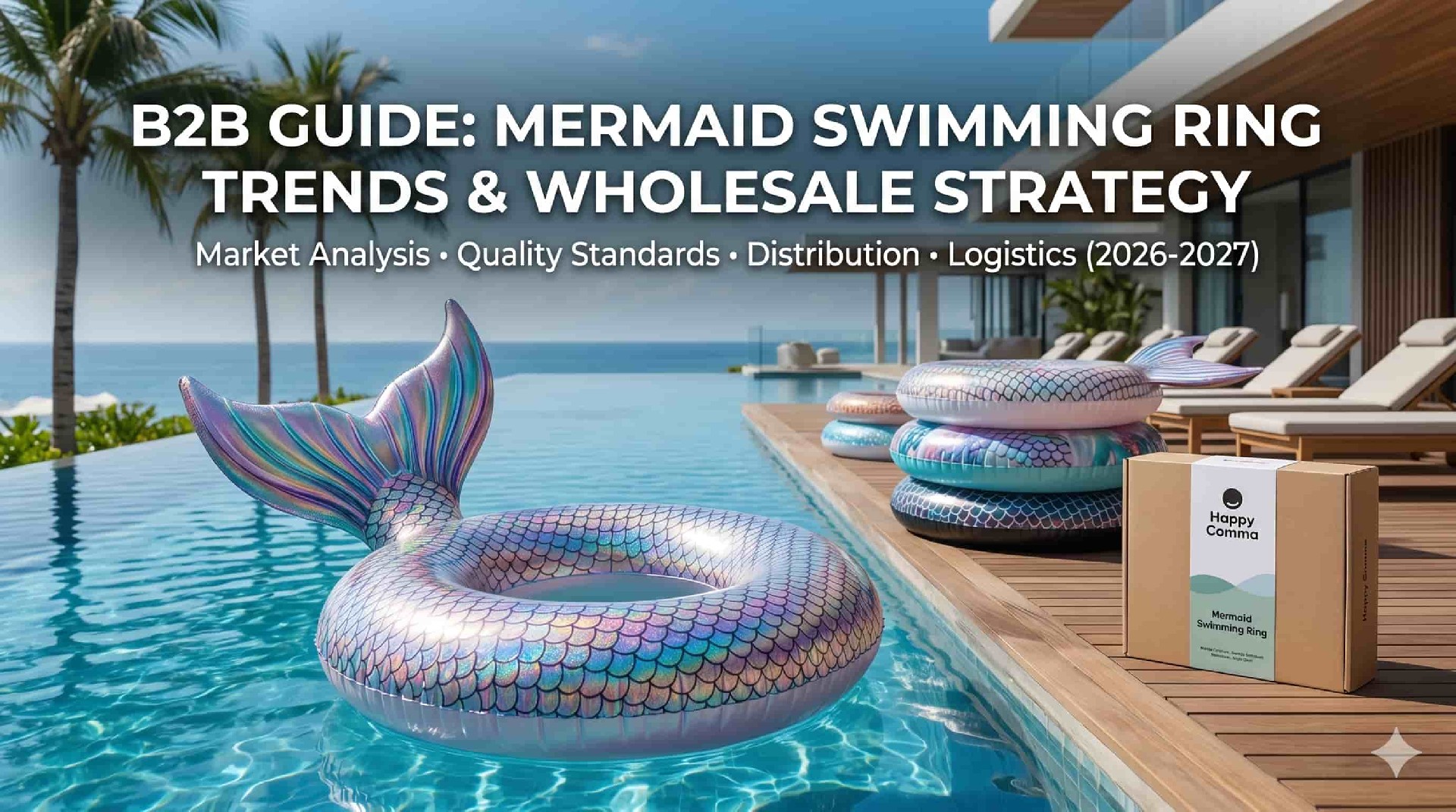
The Economic Landscape of Aquatic Leisure: Why Mermaid Designs Lead the Market
The global pool and water recreation market is no longer just about utility; it is driven by "Instagrammability" and thematic branding. According to a 2025 report by Global Market Insights, the inflatable water toy segment is projected to grow at a CAGR of 6.4% through 2030, with decorative and character-based floats leading the surge.
The
Market Drivers in 2026
Social Media Saturation: Platforms like TikTok and Instagram continue to influence hospitality purchasing. Resorts now treat pool floats as "prop assets" rather than just guest amenities.
Growth in Domestic Tourism: With the rise of private villa rentals and high-end pool ownership, the demand for premium, durable inflatables has shifted from seasonal to year-round in certain climates.
Technological Integration: High-definition digital printing has allowed for more intricate, photorealistic scale patterns on the
Mermaid Swimming Ring
Technical Specifications: Defining Quality in Mermaid Swimming Ring Manufacturing
In the B2B world, product durability directly translates to brand reputation. A low-quality inflatable leads to high return rates and safety liabilities. Understanding the technical composition of a professional-grade swimming ring is essential for any procurement officer.
Material Science: PVC vs. TPU
Traditionally, Polyvinyl Chloride (PVC) has been the industry standard. However, 2026 market standards demand "Eco-friendly PVC" or 6P-Free PVC, which eliminates harmful phthalates (DBP, BBP, DEHP, DINP, DNOP, and DIDP).
Thickness (Gauge): For commercial use, the material thickness of a
Mermaid Swimming Ring TPU (Thermoplastic Polyurethane): A rising alternative, TPU is 100% recyclable, has higher abrasion resistance, and remains flexible in colder temperatures. While the cost is 15-20% higher, it is the preferred choice for high-end European markets.
Advanced Construction Techniques
High-frequency (HF) welding is the gold standard for seam integrity. Unlike heat sealing, HF welding uses electromagnetic energy to fuse the material at a molecular level, creating a seam that is often stronger than the material itself.
| Feature | Standard Grade | Professional B2B Grade |
| Material | Standard PVC | 6P-Free / Phthalate-free PVC |
| Seam Tech | Heat Press | High-Frequency Welding |
| Valve System | Single-way Valve | Large-bore Rapid Valve (Double Leak-proof) |
| UV Resistance | Low (Fades in 1 month) | High (UV-treated for 500+ hours) |
Navigating Global Compliance: Safety and Certification Standards
Trade barriers in the water sports industry are primarily defined by safety certifications. For wholesalers importing into the US or EU, non-compliance can result in catastrophic legal costs and shipment seizures.
Essential Certifications
ASTM F963 (USA): The standard consumer safety specification for toy safety. This includes rigorous testing for small parts, sharp edges, and chemical composition.
EN71 (European Union): Specifically Parts 1, 2, and 3. This regulates physical properties, flammability, and the migration of certain chemical elements.
ISO 25649: This is a critical, often overlooked standard specifically for floating leisure articles used on and in the water. It dictates requirements for buoyancy, stability, and entrapment risks.
(Source: ISO Technical Committee 136 - Sports and other recreational facilities and equipment, 2025)
Quality Control (QC) Protocols
A reputable factory should implement a 24-hour inflation test for 100% of the production run. In this process, every
Strategic Wholesale Procurement and Supplier Selection
When sourcing from major manufacturing hubs like the Pearl River Delta in China, B2B buyers must look beyond the "Lowest Price per Unit."
Factory Auditing
Before finalizing a contract, a physical or third-party audit (such as SGS or Intertek) is mandatory. The audit should focus on:
Capacity: Can the factory handle a 50,000-unit order during the peak Q1 manufacturing season?
Social Compliance: Does the factory adhere to BSCI (Business Social Compliance Initiative) standards?
R&D Capabilities: Can they provide OEM/ODM services for custom mermaid tail shapes?
Understanding MOQs (Minimum Order Quantities)
For a customized
Branding and Customization: Beyond the Standard Mermaid Aesthetic
In a saturated market, customization is the key to differentiation. B2B clients often require bespoke features to align with their brand identity.
Customization Options
Glitter Injection: Adding iridescent PET glitter inside the transparent PVC chambers creates a "magical" effect that increases retail appeal.
Integrated Handles: For safety and transportability, heavy-duty molded handles are a must for adult-sized mermaid rings.
Bespoke Packaging: Transitioning from plastic polybags to eco-friendly FSC-certified cardboard boxes can justify a 10% price premium in eco-conscious markets.
The Role of Digital Printing
Modern digital printing allows for CMYK + White layers, enabling vibrant colors even on transparent or dark PVC backgrounds. This is particularly important for the gradient scales on a mermaid tail, ensuring they don't peel or crack under UV exposure. (Source: Journal of Polymer Engineering and Science, 2024)
Logistics and Risk Management in Cross-Border Trade
Shipping 10,000
Packing Optimization
Standardize the folding process to minimize the "CBM" (Cubic Meter) per unit. Efficient palletization can increase container utilization by up to 15%.
Sea Freight: Best for bulk seasonal orders (Lead time: 30-45 days).
Air Freight: Best for "restock" orders during a viral trend (Lead time: 5-10 days).
Tariff and Duty Considerations
Wholesalers must be aware of anti-dumping duties or specific tariffs on PVC products. For example, Section 301 tariffs in the United States may apply to certain Chinese-made inflatables. Consulting a licensed customs broker is essential during the budgeting phase.
The Future of Aquatic Entertainment: 2026 and Beyond
The industry is moving toward "Smart Inflatables" and circular economy models.
Biodegradable Materials: Research into starch-based bioplastics is accelerating. While not yet as durable as PVC, we expect to see hybrid models by 2027.
AR-Enabled Designs: Some high-end brands are incorporating QR codes on the ring that, when scanned via an app, provide an Augmented Reality (AR) "underwater kingdom" experience for children.
End-of-Life Programs: Progressive B2B distributors are implementing "Take-back" programs where old
Mermaid Swimming Rings
Frequently Asked Questions (FAQs)
1. What is the standard lifespan of a professional Mermaid Swimming Ring?
A high-quality ring made from 0.30mm PVC typically lasts 2 to 3 summer seasons with heavy use. For commercial resorts where the product is exposed to chlorine and UV daily, a 1-year lifespan is the industry benchmark for replacement cycles.
2. Is PVC safe for children’s swimming rings?
Yes, provided it is Phthalate-free and Lead-free. Ensure the product meets EN71 or ASTM F963 standards. These regulations strictly limit the chemical migration of substances that could be harmful to children’s endocrine systems.
3. Can I customize the mermaid tail shape for my brand?
Absolutely. Most top-tier manufacturers offer ODM (Original Design Manufacturing) services. This involves creating a new mold for the tail structure. Note that this usually incurs a one-time "mold fee" ranging from $800 to $2,500.
4. How do I prevent the color from fading in the sun?
Look for products treated with UV-inhibitors during the PVC extrusion process. High-quality inks used in silk-screen or digital printing should also have a UV-rating to prevent the "bleaching" effect of constant sun exposure.
5. What is the best way to repair a puncture in a mermaid ring?
For B2B applications, we recommend including a repair patch kit in every retail box. These kits usually include a TPU or PVC adhesive patch. For larger leaks, a vinyl cement glue is required for a permanent bond.
6. How does sea salt affect the material compared to chlorine?
Sea salt is less corrosive than concentrated chlorine but can leave a residue that accelerates UV degradation. It is recommended that
7. What are the shipping dimensions for a bulk order?
A typical deflated
8. What is the "inflation test" and why is it mandatory?
The inflation test involves inflating the product to 95% capacity and monitoring it for 24 hours. This identifies slow leaks in seams or valves that aren't immediately visible, reducing the "Dead on Arrival" (DOA) rate to less than 0.5%.
Conclusion
The
By prioritizing 6P-Free materials, high-frequency welding, and verified ISO-certified manufacturers, wholesalers can build a resilient product line that satisfies both retail consumers and safety inspectors. As we move into the 2026 season, the focus will increasingly shift toward sustainability and smart features—staying ahead of these trends is the key to maintaining a competitive edge in the global aquatic leisure industry.
