

Executive Summary
The global market for outdoor recreation and event supplies is witnessing a massive surge in demand for portable, space-saving, and cost-effective beverage cooling solutions. Traditional hard-shell coolers, while durable, present logistical challenges in storage, shipping, and event setup. Enter the wholesale PVC inflatable ice bucket—a highly versatile, customizable, and high-margin product that is revolutionizing how distributors, retailers, and event planners manage beverage service for graduation seasons, pool parties, and outdoor events. This comprehensive whitepaper explores the material science, manufacturing processes, market dynamics, and strategic sourcing benefits of inflatable beverage cooling ice bars, providing B2B buyers with the actionable intelligence needed to optimize their procurement strategies.
Introduction: The Evolution of Outdoor Beverage Cooling
As consumer preferences shift toward dynamic, aesthetically pleasing, and highly mobile outdoor gatherings, the equipment supporting these events must adapt. The traditional static cooler is increasingly being supplemented—or entirely replaced—by flexible, inflatable alternatives.
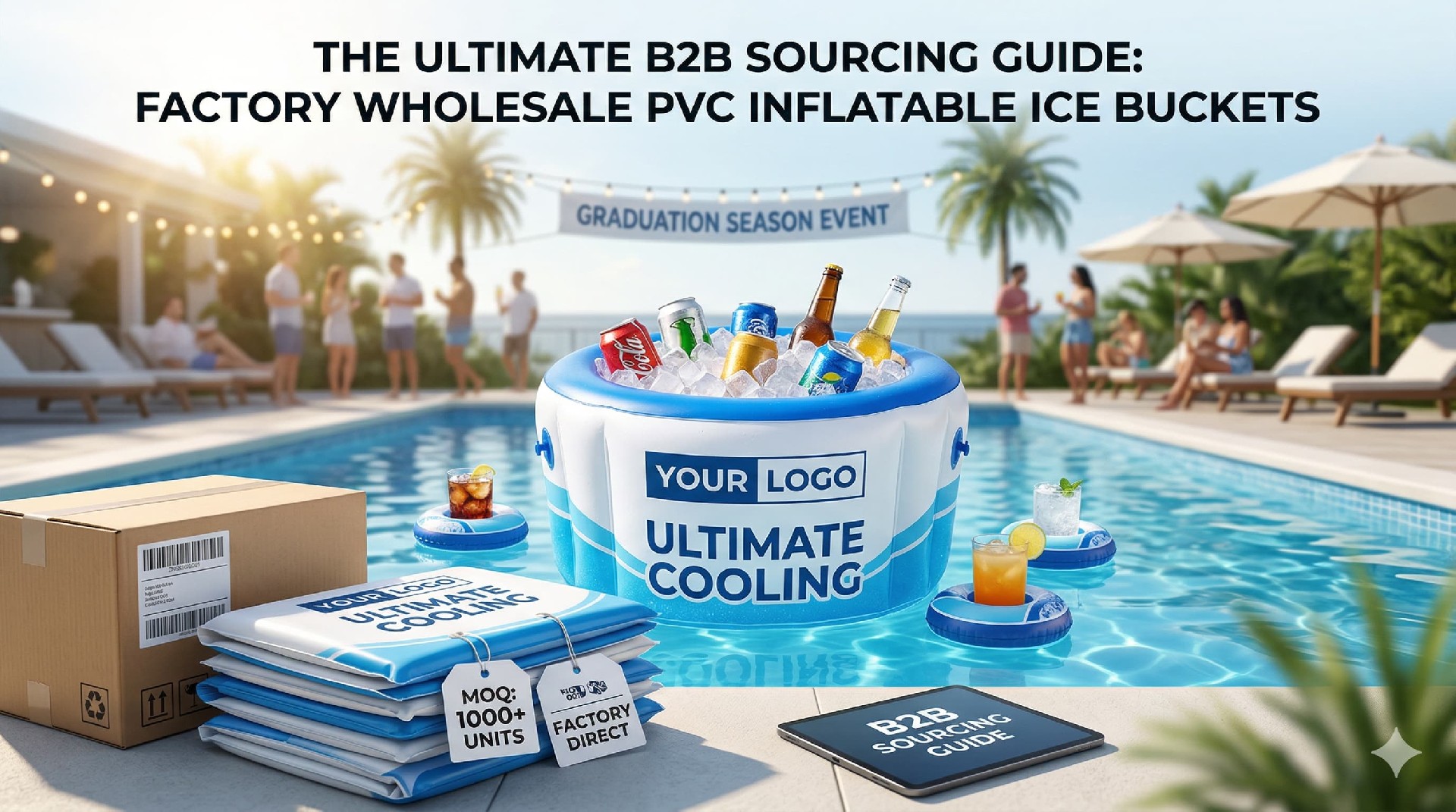
For wholesale buyers, distributors, and promotional product agencies, sourcing a factory wholesale PVC inflatable ice bucket presents a distinct competitive advantage. These products, often designed as floating coasters or expansive buffet bars, offer a unique combination of utility and novelty. They are engineered to keep beverages chilled using ice while remaining buoyant in pools or serving as lightweight tabletop stations at graduation parties, corporate retreats, and summer festivals.
Understanding the technical specifications and market applications of these bulk inflatable drink holders is critical for maximizing Return on Investment (ROI) and meeting the seasonal spikes in consumer demand.
Material Science: Why High-Density PVC is the Industry Standard
The viability of an inflatable floating cooler for pool use relies entirely on its material integrity. In the manufacturing of premium inflatable coolers, standard plastics are insufficient. The industry standard is high-density Polyvinyl Chloride (PVC), specifically formulated for aquatic and outdoor environments.
The Superiority of PVC
Thermal Resistance: High-quality PVC possesses inherent insulating properties. While not equivalent to rotational-molded polyurethane foam, thick PVC (typically ranging from 0.20mm to 0.35mm for commercial-grade inflatables) effectively creates a barrier between the ambient temperature and the ice-water mixture inside the bucket, slowing the melting process.
Tensile Strength and Puncture Resistance: Outdoor party environments are rigorous. The PVC utilized in these products must withstand scraping against concrete pool edges, wooden decks, and the sharp edges of bottle caps.
Flexibility and High-Frequency Welding: PVC is uniquely suited for high-frequency (HF) welding. This manufacturing technique uses electromagnetic energy to fuse the material at the molecular level, creating seams that are often stronger than the surrounding material. This guarantees a watertight and airtight seal, essential for an outdoor party beverage cooling ice bar.
Safety and Environmental Compliance
For B2B buyers importing into Western markets, environmental and health compliance is paramount. Reputable factories utilize eco-friendly, non-toxic PVC.
Phthalate-Free (6P/10P): To comply with regulations like the CPSIA (USA) and REACH (Europe), buyers must ensure the PVC used is free from harmful phthalates.
Food-Grade Certification: Since these products often come into direct contact with ice that may touch beverage containers, ensuring the material meets basic food-contact safety standards is a critical procurement step.
Market Applications and Seasonal Demand Surges
The profitability of sourcing these products lies in their broad application across various consumer segments.
The Graduation Season Boom
Graduation parties are large-scale, often outdoor gatherings that require cost-effective catering solutions. A graduation party inflatable ice bucket or buffet bar allows hosts to set up expansive beverage stations across yards and patios without the expense of renting heavy catering equipment. Retailers stocking these items see exponential sales growth between April and June in the Northern Hemisphere.
Pool Parties and Aquatic Recreation
The "floating bar" concept has transitioned from luxury resorts to residential backyards. Inflatable ice buckets designed with enhanced buoyancy chambers allow users to access chilled drinks without leaving the water. These SKUs often feature integrated cup holders (floating coasters) and tie-down ropes to anchor the cooler to the pool edge.
Tailgating and Camping
The flat-pack nature of uninflated PVC products makes them ideal for campers and tailgaters who have limited vehicle cargo space. Once deflated, an inflatable ice bar that can hold 50 cans reduces to the size of a folded sweater.
The Economics of Factory Wholesale Sourcing
For procurement professionals, buying direct from a custom inflatable cooler manufacturer offers significant financial and logistical benefits.
Maximizing Margins through Space Efficiency
The most profound advantage of inflatable PVC products is their shipping footprint. When shipping traditional hard coolers, buyers are essentially paying to ship empty air. In contrast, inflatable ice buckets are shipped fully deflated and tightly flat-packed.
Logistics Impact: A standard 20-foot shipping container might hold 500 hard-shell coolers. The same container can hold 20,000+ deflated inflatable ice buckets. This drastically lowers the Landed Cost per Unit, allowing for retail markups of 200% to 400%.
OEM/ODM Customization Opportunities
B2B buyers are not limited to stock designs. Partnering with a factory allows for Original Equipment Manufacturing (OEM).
Corporate Gifting: Beverage companies (breweries, energy drink brands) frequently order custom-shaped inflatable coolers (e.g., shaped like their flagship can or bottle) as point-of-sale (POS) marketing materials or promotional giveaways.
Pantone Matching and Silkscreening: Factories can match the exact Pantone colors of a brand and utilize advanced silkscreen or UV printing to apply high-resolution logos that resist fading in the sun.
Comparative Analysis: Inflatable vs. Traditional Coolers
To properly position this product to end-users or retail partners, distributors must understand how it compares to traditional options.
| Feature | Factory Wholesale PVC Inflatable Ice Bucket | Traditional Hard-Shell Cooler |
| Storage & Shipping Volume | Extremely Low (Flat-packed) | Extremely High (Rigid structure) |
| Wholesale Cost | Low ($1.50 - $5.00/unit in bulk) | High ($20.00 - $150.00+/unit) |
| Primary Use Case | Display, Parties, Poolside, Buffets | Long-term camping, deep wilderness |
| Ice Retention Time | 4 to 8 hours (Event duration) | 2 to 7 days |
| Aesthetic Customization | Limitless shapes, full CMYK printing | Limited to surface decals or mold colors |
| Portability (Empty) | Fits in a tote bag or glove compartment | Requires trunk space or truck bed |
Quality Control: Vetting Overseas Manufacturers
Not all inflatable manufacturers operate at the same standard. When issuing a Request for Quotation (RFQ) for bulk inflatable drink holders, B2B buyers must enforce strict Quality Control (QC) parameters.
The 24-Hour Inflation Test: A reputable factory will conduct a mandatory 24-hour inflation test on 100% of the units before packaging. If a unit loses significant pressure within this window, it is rejected for seam leakage or faulty valves.
Valve Quality: Specify the use of double-lock valves or Boston valves. These prevent air from escaping when the pump is removed and allow for rapid deflation after the event.
Thickness Tolerance: If your contract specifies 0.25mm PVC, ensure your third-party inspection agency uses micrometers to verify the thickness. Thinner PVC will severely compromise the product's lifespan and structural integrity when loaded with heavy ice and beverages.
Frequently Asked Questions (FAQ)
To streamline the procurement process and address common B2B inquiries, we have compiled the definitive answers regarding the sourcing and utilization of inflatable ice buckets.
Q1: How long can a PVC inflatable ice bucket keep beverages cold?
A: Unlike rotomolded coolers designed for multi-day trips, an outdoor party beverage cooling ice bar is designed for event-duration cooling. Depending on ambient temperature and ice volume, it typically keeps beverages ice-cold for 4 to 8 hours, making it perfect for afternoon pool parties or graduation events.
Q2: What is the standard Minimum Order Quantity (MOQ) for factory direct purchases?
A: For stock, unbranded designs, factories may accept MOQs as low as 500 units. For custom shapes, Pantone matching, or branded silkscreen printing (OEM orders), the MOQ generally ranges from 1,000 to 3,000 units to offset the costs of new high-frequency welding molds and printing plates.
Q3: Can these inflatable coolers be used in chlorinated or saltwater pools?
A: Yes. Commercial-grade PVC is highly resistant to standard pool chemicals, including chlorine and bromine, as well as saltwater. However, it is recommended to rinse the product with fresh water after use and dry it completely before storage to prevent mildew and prolong its lifespan.
Q4: Will the condensation from the ice damage indoor tables or hardwood floors?
A: Because PVC is not heavily insulated, condensation will form on the exterior of the inflatable cooler as the ice melts inside. If used indoors on sensitive surfaces like hardwood, a protective towel or waterproof mat should be placed underneath. They are primarily designed as an outdoor party beverage cooling ice bar.
Q5: How do users empty the melted ice water after the event?
A: Premium designs feature an integrated drainage plug at the base of the cooler. This allows users to easily drain the water into a yard or sink without having to lift and tip a heavy, water-filled inflatable.
Q6: What safety certifications should I request from a custom inflatable cooler manufacturer?
A: For the US market, request ASTM F963 and CPSIA compliance (ensuring lead and phthalate limits). For Europe, require EN71 and REACH compliance. Additionally, ensure the factory itself holds ISO 9001 certification for quality management.
Q7: Can sharp ice puncture the PVC material?
A: Standard cubed or crushed ice will not puncture 0.25mm or thicker PVC. However, users should be cautioned against dropping heavy, sharp-edged blocks of ice directly into an empty bucket. It is best practice to add a small amount of water or gently place the ice inside.
Q8: Are the floating coasters stable enough to hold glass bottles in a pool?
A: Yes, floating inflatable ice buckets are engineered with wide bases and separate air chambers to ensure buoyancy and stability. However, for safety reasons regarding potential breakage in swimming pools, it is strongly recommended to use aluminum cans or plastic bottles rather than glass.
Core Value Summary
The factory wholesale PVC inflatable ice bucket represents a highly strategic addition to the inventory of any B2B buyer operating in the party supply, promotional goods, or outdoor recreation sectors.
Its core value is rooted in its unparalleled logistical efficiency: the ability to ship and store tens of thousands of units at a fraction of the cost of rigid coolers. For the end-user, it solves the immediate problem of accessible, affordable, and aesthetically pleasing beverage management for graduation parties, pool gatherings, and outdoor buffets. By partnering directly with a vetted custom inflatable cooler manufacturer, buyers can leverage OEM capabilities to create highly branded, high-margin products that capitalize on seasonal consumer demand while maintaining strict adherence to international material safety standards.
