

The Comprehensive Engineering and Selection Guide to the Car Roof Tent for Hiking & Camping
Abstract
As overland travel and vehicle-based expeditions redefine modern outdoor recreation, the car roof tent has transitioned from a niche luxury to a fundamental piece of engineering for serious adventurers. This whitepaper explores what exactly makes modern rooftop tents (RTTs) technologically superior to traditional ground setups, diving deep into material science, aerodynamic impacts, and structural load-bearing capacities. Why is this critical now? With the global overlanding market experiencing a compound annual growth rate (CAGR) of over 11% (Source: SEMA Market Report, 2025), optimizing your vehicle's payload and camp setup efficiency is paramount for safety and comfort. Throughout this comprehensive guide, you will learn how to evaluate dynamic versus static weight limits, select between hard-shell and soft-shell architectures based on thermodynamic retention, and seamlessly integrate terrestrial camping gear with aquatic equipment. By mastering these technical strategies, outdoor enthusiasts, B2B fleet managers, and gear outfitters can make data-driven decisions that maximize both vehicle performance and off-grid endurance.
The Evolution of Overland Camping: Why the Car Roof Tent is Dominating the Market
The paradigm of hiking and camping has shifted significantly over the last decade. Traditional ground tents, while lightweight and versatile for backcountry backpacking, present distinct vulnerabilities when integrated into a motorized overland workflow. The emergence of the car roof tent represents a critical evolution in outdoor architecture, moving the shelter off the unpredictable ground and onto a controlled, engineered platform.
According to the 2024 Kampgrounds of America (KOA) North American Camping Report, over 45% of new campers are prioritizing elevated off-ground sleeping solutions to mitigate terrain irregularities and wildlife encounters. The car roof tent leverages the existing footprint of the vehicle, effectively turning any flat, drivable surface into a highly functional basecamp. From a technical perspective, this shift eliminates the need to clear debris, assess ground slope for drainage, or worry about subterranean moisture penetration.
Furthermore, the rapid deployment capability of modern rooftop tents—often under 60 seconds for gas-strut-assisted hard shells—drastically reduces the metabolic energy expended during camp setup. This efficiency is crucial for overland expeditions where daily relocation is common. By analyzing the structural mechanics of vehicle roof racks and the aerodynamic profiles of closed tents, we can understand why the car roof tent has become the gold standard for expedition vehicles, seamlessly bridging the gap between raw wilderness exposure and RV-level comfort.
Decoding the Aerodynamics and Structural Integrity of Rooftop Tents
Installing a large structural object on top of a moving vehicle alters its center of gravity, aerodynamic drag coefficient, and structural load distribution. Understanding these engineering constraints is non-negotiable for safety and performance.
Static vs. Dynamic Weight Limits Explained
The most critical metrics in car roof tent deployment are the Dynamic Weight Capacity (DWC) and Static Weight Capacity (SWC) of your vehicle's roof and the aftermarket crossbars.
Dynamic Weight Capacity: This refers to the maximum load the vehicle's roof can safely support while in motion. When navigating highways at 70 mph or traversing corrugated dirt roads, the kinetic energy exerted on the roof rack multiplies significantly. A standard SUV might have a dynamic load rating of 165 lbs (75 kg). Therefore, the weight of the car roof tent itself must not exceed this metric.
Static Weight Capacity: This is the load the roof can support when the vehicle is stationary. Fortunately, vehicle frames are engineered to withstand rollover events, meaning their static capacity is vastly higher—often exceeding 600 lbs (272 kg). This allows a 150 lb tent, plus two 200 lb adults and gear, to safely rest on the roof without compromising the vehicle's structural integrity.
To safely utilize a car roof tent, you must upgrade from factory crossbars to extruded aluminum aftermarket roof racks (such as Prinsu, Front Runner, or Rhino-Rack) that distribute the footprint load across the vehicle's strongest structural seams.
Aerodynamic Drag and Fuel Efficiency Impacts
A poorly designed car roof tent acts as an air brake. The frontal area of the tent increases the vehicle's total drag coefficient (Cd). According to a 2025 study by the Automotive Aerodynamics Research Council, mounting a non-aerodynamic box on an SUV can reduce highway fuel efficiency by 15% to 22%.
Modern manufacturers mitigate this by utilizing wedge-shaped hard shell designs or low-profile aluminum clam-shells that measure less than 6 inches in thickness when closed. By deflecting air over the top of the vehicle rather than catching it, these optimized designs reduce the MPG penalty to a manageable 5-8%, preserving the overland vehicle's effective range.
Hard Shell vs. Soft Shell Car Roof Tents: A Comprehensive Technical Analysis
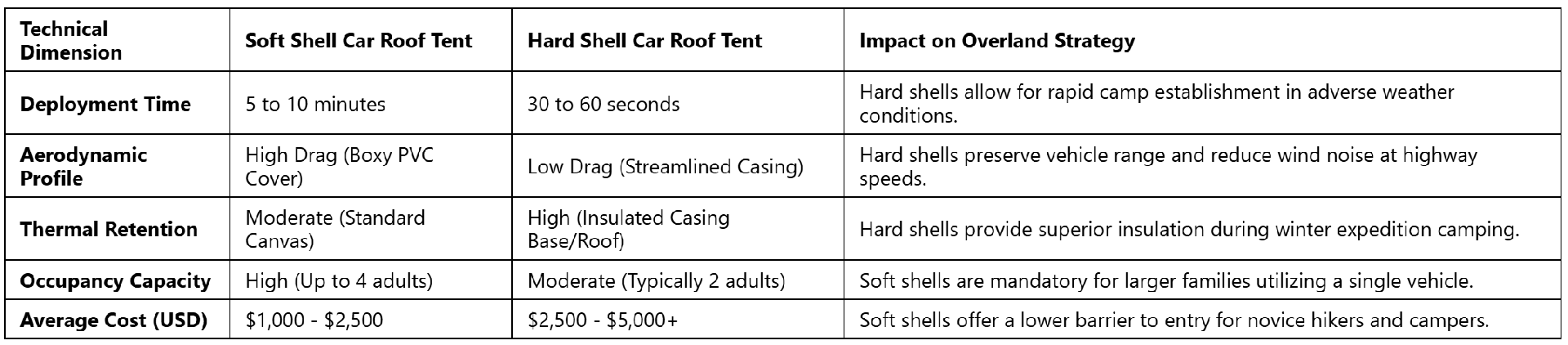
When selecting a car roof tent, the primary architectural decision lies between soft-shell and hard-shell designs. Each presents a distinct matrix of advantages regarding deployment speed, interior volume, thermal efficiency, and cost.
Soft Shell Rooftop Tents: The Traditional Workhorse
Soft-shell tents resemble traditional ground tents but are constructed on an engineered folding baseplate. They utilize a bi-fold or tri-fold mechanism, expanding outward to double their footprint. This allows them to offer massive internal square footage, often accommodating three to four people.
Advantages: Lighter weight (often under 120 lbs), smaller closed footprint on the roof, massive deployed volume, lower entry cost.
Disadvantages: Aerodynamically inefficient, slower setup/takedown time (5-10 minutes), prone to wind flap noise, and the PVC travel cover can be difficult to zip in cold weather.
Hard Shell Rooftop Tents: The Modern Standard
Hard-shell tents utilize a rigid top and bottom casing, typically manufactured from ABS plastic, fiberglass, or honeycombed aluminum. They deploy vertically via hydraulic gas struts or scissor-lift mechanisms.
Advantages: Near-instant deployment (under 60 seconds), superior aerodynamics, excellent weather resistance, capability to mount solar panels directly to the top shell.
Disadvantages: Higher weight penalty (150-220 lbs), smaller internal footprint (usually limited to two people), higher capital investment.
Comparative Analysis Table
Advanced Material Science in Modern Rooftop Tents
The longevity and comfort of a car roof tent are inextricably linked to the textiles and composite materials used in its construction. B2B manufacturers and consumers alike must scrutinize these specifications.
Fabric Denier, Poly-Cotton Blends, and Ripstop Technology
Unlike lightweight backpacking tents that use 15D or 20D sil-nylon to save weight, a car roof tent relies on heavy-duty fabrics capable of withstanding severe UV radiation, heavy snow loads, and gale-force winds. The industry standard has shifted toward Poly-Cotton Ripstop Canvas, typically in the 280g to 320g per square meter (GSM) range.
Ripstop Grid: A reinforcing technique where thicker threads are interwoven in a crosshatch pattern. If a branch punctures the tent, the tear is halted at the nearest grid line, preventing catastrophic failure.
Poly-Cotton Synergy: Polyester provides UV resistance and rapid drying capabilities, while natural cotton fibers swell when wet, naturally sealing the stitching holes and enhancing water resistance.
Hydrostatic Head (HH) Ratings and Weatherproofing
Waterproofing is measured via a Hydrostatic Head rating, which indicates the millimeter height of a water column the fabric can support before moisture penetrates. A high-quality car roof tent should boast a minimum HH rating of 3,000mm on the canopy and up to 5,000mm on the rainfly. Furthermore, the fabric must undergo Polyurethane (PU) coating and feature factory-taped seams to guarantee total impermeability during torrential storms. (Source: Outdoor Gear Builders Association, 2025).
Heating, Ventilation, and Air Conditioning (HVAC) Mechanics
One of the most complex engineering challenges in any car roof tent is moisture management. The human body exhales approximately 400ml of water vapor overnight. In a sealed, highly insulated environment, this vapor quickly condenses on cold surfaces, leading to a damp mattress and freezing conditions.
Mitigating Condensation
To counteract this, premium rooftop tents integrate sophisticated passive HVAC systems.
Anti-Condensation Mats: Placed beneath the high-density foam mattress, these 3D woven polymer mats create a 10mm air gap. This gap allows ambient air to circulate beneath the sleeper, pushing evaporated moisture out of the tent before it can condense and pool on the cold aluminum baseplate.
Cross-Ventilation Engineering: strategically placed awnings over the windows allow users to keep the vents open even during heavy rain. This constant thermodynamic exchange of interior warm air and exterior cold air is crucial for a dry sleeping environment.
Synergizing Rooftop Tents with Broader Overland and Aquatic Gear
A car roof tent does not exist in a vacuum; it is part of a holistic overland ecosystem. Advanced campers frequently combine terrestrial camping with aquatic exploration, demanding a vehicular setup that can accommodate both.
When deploying an aluminum hard-shell car roof tent, many users take advantage of the integrated T-slot channels on the perimeter of the tent's roof. These extruded channels allow for the mounting of specialized crossbars on top of the tent itself. This is a game-changer for multi-sport enthusiasts.
For example, when planning an extended expedition that involves both mountain hiking and lake navigation, users can securely mount lightweight composite watercraft above the tent. If your itinerary involves deep-water fishing, securely strapping a
Similarly, for those optimizing roof space, a hard-shell tent with load-bearing crossbars can easily accommodate a
Future Trends: Smart Integration and Eco-Friendly Materials
The next generation of car roof tent manufacturing is heavily focused on sustainability and off-grid technological integration. As battery densities increase and flexible solar panels become more efficient, the rooftop tent is evolving from a passive shelter into an active energy hub.
Integrated Solar and Power Management
Future iterations of hard-shell tents feature flush-mounted, semi-flexible monocrystalline solar panels built directly into the top casing. These panels, often rated between 100W and 200W, connect directly to the vehicle's secondary deep-cycle battery or portable power stations (like Jackery or EcoFlow). This provides a continuous trickle charge to power internal LED strip lighting, 12V heated blankets, and mobile devices without running the vehicle's alternator.
Sustainable Fabric Innovations
In response to global ESG (Environmental, Social, and Governance) pressures, manufacturers are phasing out toxic DWR (Durable Water Repellent) coatings containing PFAS (per-and polyfluoroalkyl substances). The industry is pivoting toward environmentally inert silicone-based water repellents and utilizing fabric canopies woven from 100% recycled PET plastics (Source: Global Outdoor Industry Sustainability Report, 2026). This shift ensures that the pursuit of outdoor exploration does not actively degrade the environments we seek to enjoy.
Frequently Asked Questions (FAQs)
1. Is a car roof tent safe during thunderstorms?
Yes. A car roof tent is remarkably safe during lightning storms because the vehicle acts as a Faraday cage. The metal chassis of the car directs the electrical current around the cabin and safely into the ground via the tires, protecting the occupants inside the tent.
2. Can any car accommodate a rooftop tent?
Not every vehicle. Your car must have a dynamic roof weight capacity that exceeds the weight of the tent (usually 100-200 lbs). You must also upgrade from factory crossbars to heavy-duty aftermarket roof racks to handle the structural load properly.
3. Do car roof tents affect fuel economy?
Yes, installing a car roof tent increases aerodynamic drag. Soft-shell tents typically reduce fuel efficiency by 10-15%, while highly aerodynamic, low-profile hard-shell tents may only cause a 5-8% reduction in MPG.
4. How do you heat a rooftop tent in the winter?
Winter campers utilize 12V heated blankets powered by portable lithium power stations, or they pipe in hot air using external portable diesel heaters. The thick, insulated poly-cotton canvas of high-end tents also retains human body heat efficiently.
5. Are rooftop tents waterproof?
Premium car roof tents are highly waterproof, utilizing high-density ripstop canvas with polyurethane coatings and factory-sealed seams. Look for a minimum Hydrostatic Head (HH) rating of 3,000mm to ensure protection during heavy downpours.
6. Can I leave my car roof tent on all year?
While possible, it is not recommended if you live in areas with harsh winters and road salt, which can degrade the hinges and zippers. Removing it when not in use preserves the fabric lifespan, improves daily fuel economy, and reduces center-of-gravity hazards.
7. How much weight can a car roof tent hold inside?
Most high-quality car roof tents are engineered with a static weight capacity ranging from 600 to 800 lbs. This is more than sufficient to safely support two to three adult occupants, a heavy mattress, and camping gear.
8. Do I need a custom roof rack for installation?
Factory-installed crossbars are generally too weak for rooftop tents. You must install aftermarket crossbars (like Thule or Yakima) or a specialized platform rack rated for high dynamic loads to safely mount the tent hardware.
Conclusion
The transition from traditional ground camping to utilizing a car roof tent is a significant upgrade in overland engineering, safety, and comfort. By understanding the critical importance of dynamic weight limits, aerodynamic profiles, and the advanced material science behind poly-cotton ripstop fabrics, outdoor enthusiasts can elevate their expedition capabilities. Whether you are outfitting a heavy-duty truck for a trans-continental journey or equipping a compact SUV for weekend hiking trips seamlessly integrated with water sports, the right rooftop tent acts as the ultimate off-grid basecamp.
